

“Fashion is an intrinsic part of what constructs the identity of the character in a film. This applies to lines, colors, looks, and any fashion-related accessories. It’s been there since the inception of cinema.”
– Professor Sylvie Blum-Reid
As stories unfold through visuals and narratives in the world of cinema, fashion stands out as one of the integral elements to character portrayal. As Sylvie Blum-Reid, esteemed professor of French and film at the University of Florida, eloquently expresses, “Fashion is an intrinsic part of what constructs the identity of the character in a film. This applies to lines, colors, looks, and any fashion-related accessories. It’s been there since the inception of cinema.”
Blum-Reid’s profound insight underscores the intricate relationship between fashion and character development and reveals how attire serves as a vehicle for storytelling to convey nuances of personality, social status, and cultural context. With a scholarly background deeply rooted in French literature and film studies, Professor Blum-Reid brings a wealth of knowledge to her exploration of this intersection between women, fashion, and film.
Throughout her illustrious career, Professor Blum-Reid has explored diverse realms of cinematic expression, from the golden age of French cinema to contemporary productions. Her research interests span a wide spectrum, including 1930s French cinema, fashion and film, photography, and the creative endeavors of women artists and writers during the interwar years.
In her teachings, Professor Blum-Reid illuminates the significance of fashion in cinematic narratives and invites students to dissect the visual language of attire and its implications for character identity. Whether analyzing iconic films like Jacques Becker’s “Falbalas” or Jean-Luc Godard’s “Breathless,” Blum-Reid guides her students through a journey of discovery to uncover the intricate symbiosis between fashion aesthetics and narrative themes.
Drawing from her extensive studies, Blum-Reid sheds light on the evolution of fashion representations in cinema, from the glamorous allure of Hollywood to the avant-garde sensibilities of European cinema. She examines how fashion trends, from Coco Chanel’s revolutionary designs to contemporary haute couture, mirror the shifting cultural landscapes of their respective eras.
Moreover, Blum-Reid’s research extends beyond the silver screen and tackles the cultural milieu of interwar Europe, where expatriate female artists and writers left their mark on fashion aesthetics. Through her meticulous scholarship, she presents the intertwined nature of creativity, identity, and societal change that permeate fashion history.
In this Q and A, let us take a closer look at celluloid dreams and sartorial splendor through the lens of Professor Blum-Reid.
SM: As a scholar with a background in French literature and film studies, how did you become interested in the portrayal of women and fashion in cinema?
PSBR: I think it sort of came naturally after years of teaching material related to women in French cinema (women’s films, women in film), and even European cinema or other. Also, with some of the literature I was reading, Colette for instance on mannequins, or bras (undergarments), or Gertrude Stein and Alice B. Toklas, two American expatriate writers in France, who were both fashionistas and careful about what they wore (designers’ clothes). It’s possible that my family background on my father’s side guided me in that direction unknowingly as my grandparents ran a clothing store in Montmartre in the 1930s-1950s, and my maternal grandparents had lace-making workshops in Northern France. My godmother was a Parisian couturière. Two close family friends were vintage enamel jewelry artists. I grew up in such a milieu heavily influenced by fabric, designs and questions of taste, and elegance. However, I have watched enough films to understand the way that designers work together with the scriptwriter, director, and cinematographer to make everything coalesce for the story. There is a language behind all this, and I always felt like deciphering it.
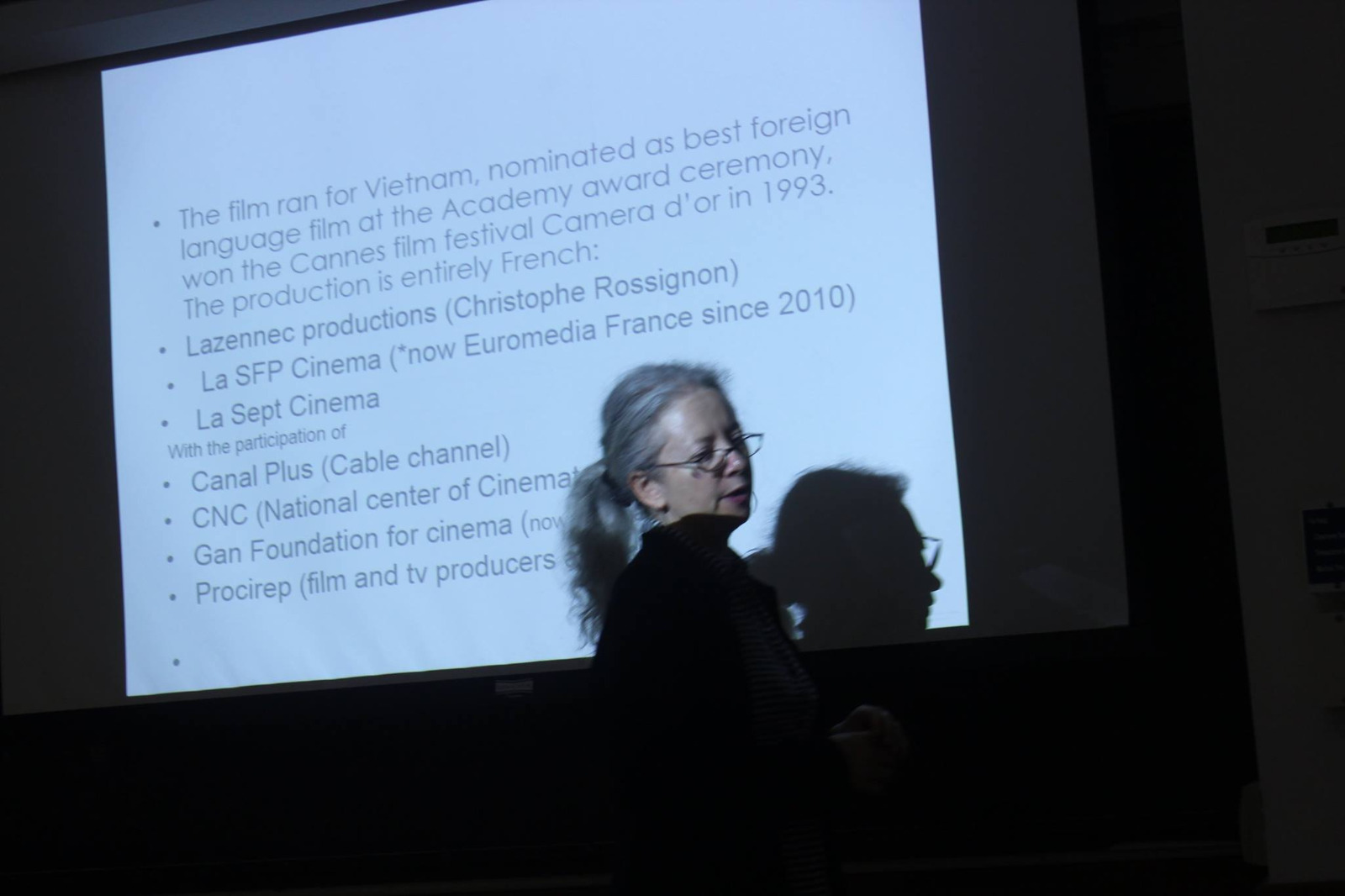
[Caption credit: Professor Blum-Reid. Photo credit: Kole Odutola.]
SM: Could you share some examples of iconic films that have effectively captured the essence of women’s fashion and its role in storytelling?
PSBR: One film that stands out is Jacques Becker’s 1944 Falbalas (Paris Frills), entirely located in a couture house; the male designer, a playboy, surrounded by women (petites mains, mannequins, premieres etc.) succumbs to love and becomes crazy (not to ruin to plot, I will avoid revealing much of the ending). The film was made during war time. Next, one can think of L’Atalante (Jean Vigo, 1933), literally plunging into life on a barge with a newlywed woman (Juliette) who wants to experience Paris fashion firsthand, and is connected to it via radio advertisements broadcasts. Jean-Luc Godard’s A bout de souffle (Breathless 1959) also illustrates the arrival of the American woman in France (Jean Seberg) and her rather casual look as she strolls down the Champs Elysées selling her New York Herald Tribune in a tee-shirt and dark capri pants and ballerinas. I can only imagine the way the film was first received at the time! Unforgettable as well are most of Audrey Hepburn’s roles in European-based films with her iconic outfits designed to reproduce the French ‘look’, or the existentialist gamine style. The assistance of designers like Givenchy, Rochas etc. accompanies such films. Sabrina, and Funny Face are markers of such time when fashion makes a difference in the life of a person and are still relevant today. Not to forget Brigitte Bardot’s simple outfits or lack thereof in Vadim’s Et dieu créa la femme (And God Created Woman, 1956). The list goes on… to cite a more ‘recent’ film, that involves Catherine Deneuve (a French fashion icon throughout her career), I would list François Ozon’s 8 women (1999) as an iconic representation of fashion in film, involving several generations of actresses in a crime story.
SM: From the golden age of Hollywood to contemporary cinema, how have representations of female characters and their fashion evolved over time?
PSBR: Hollywood has tried to follow a certain style and fashion trends; however, it relies heavily on American fashion. It is rare that American cinema would recruit a French couturiere. The example of Coco Chanel comes to mind, as she was recruited to Hollywood by Samuel Goldwin, however, the ‘experiment’ for her was a fiasco. She did not like being told what to do, and I think that some actresses did not like to wear her gowns (i.e. Tonight or Never 1931). Since Chanel attempted to ‘liberate’ women’s bodies from girdles, this was not exactly welcome. Chanel said that she was interested in creating fashion not (film) costumes. The simplicity of her ‘little black dress’ and the pearl necklace have long lasting effects until now. Many American actresses (film and theatre) flocked to Paris for outfits by Chanel, Schiaparelli or later, Givenchy, and Dior. I’m not sure that I have answered your question here.

SM: How do you analyze the relationship between fashion and identity as depicted in film narratives, particularly in relation to female protagonists?
PSBR: Fashion is an intrinsic part of what constructs the identity of the character in a film. This applies to lines, colors, looks, and any fashion related accessories. It’s been there since the inception of cinema. However, not every film is exactly mindful of the role of fashion and characters as important agents for the narrative.
SM: Your research interests also include expatriate female artists in the interwar period. How do you see their influence reflected in the fashion aesthetics of the films from that era?
PSBR: My research and teaching interests include expatriate female artists in France; some of them worked either in the fashion industry or were in its periphery with their own design and color theories. Due to their presence and international flair, they helped influence several aspects of fashion, and prompted experimentation with material, designs, in garments and jewelry. Just one example that comes to mind is Elsa Schiaparelli (Italian) who had a couture house in Paris, and also lived in the US and England; she was associated with Surrealist artists in the 1920s and 1930s. She helped with some of the lines and creative instances. She is at the origins of ‘streetwear’ fashion. Her house has been revived recently (Place Vendôme).
Sonia Delaunay, a painter (from Ukraine) is now being reconsidered however, it’s too early to see her connection with film, at least in what I have read so far.

SM: In your opinion, what distinguishes the portrayal of fashion in European cinema compared to American cinema, and are there any notable differences in how female characters are styled and represented?
PSBR: I admit here that I’m not an expert in American cinema (although I live in North America). I would just say that American film productions have had a different approach to costume designs than in Europe. It’s more codified. Each studio has their own film designer(s). Just looking at French films over the ages, one can tell that there is always a possibility to use a specific style, and ‘stylist’, to also add a special touch, and create a design that is not just strictly emanating from the film traditional wardrobe. This adds a bit more leeway with experimenting with fabric, designs, and such. American actresses have always been impeccably dressed and coiffed in films, but one is hard-pressed to attribute the name of the designer to their outfit. [i] It’s not like what we find in Who are you, Polly Maggoo? (William Klein, 1966) which is a satire of the fashion world yet provides an insight into such designers as Paco Rabanne (at the time) and the Carita sisters (hairdressers)! Similarly, the character of Nelly (Michèle Morgan) as it was constructed in Quai des Brumes (Port of Shadows, Marcel Carné, 1938) stands out in her simplicity, and originality (a simple trench coat and a beret) to convey her persona, and difference. [ii]
SM: As a dual language degree coordinator and affiliate faculty in various interdisciplinary programs, how do you incorporate discussions about women, fashion, and film into your teaching curriculum?
PSBR: As an affiliate of Women and Gender Studies, as well as Film Studies, I have been able to integrate classes that combine film, and literature in the area of fashion. Sometimes, even if fashion takes a back seat on the syllabus, and main goal as in for example a French composition class, it inevitably pops up. So, the discussions grow organically. Students who at first think that they are not knowledgeable in the area (of fashion, film and women in film) quickly realize that they are actually able to contribute to the class, with their own reading background (not to mention their knowledge of film). I’ve had a student who was a model in New York, some who are anti-fashion, others who are fashionistas; some have read Vogue since they were children; all of them do well in such classes and are very much informed in todays’ fashion. I have had fascinating final research projects and oral presentations each time I teach the class, which adds another dimension to it. As far as languages are involved, there is an international couture language, that includes many French based terms: from ‘couture’, to ‘petite main’, to ‘chemise’, ‘chiffon’, to ‘bateau’ neckline… to cite a few….so students from all fields are an integral part of such classes.

PSBR: Are there any specific themes or motifs related to women’s fashion in film that you find particularly intriguing or recurrent across different cinematic genres?
SM: Maybe the fact that fashion is cyclical, and some styles resurface and are recurrent. I’m thinking of shoes for instance, and how the platform shoes inevitably make a comeback – from World War II where the platform shoe was present to today; not to mention the recurrent use of ‘corset’ or bustier who is apparently making a comeback (I’m told by students)! I’m intrigued by hats, and the fact that women up to a certain era were supposed to wear hats outdoors; nowadays, it is mostly seen as extravagant, and/or whimsical and definitely making a statement. But think of Sabrina (Audrey Hepburn) wearing her small hat upon her return from Paris at the small train station in upstate New York, “a miniature turban of pleated pearl-grey chiffon, created by Givenchy’s in-house milliner.” [iii]

SM: Your background includes extensive studies in literature, film, and photography. How do these interdisciplinary perspectives inform your analysis of fashion in film, and do you draw parallels between visual aesthetics and narrative themes?
PSBR: Fashion involves a certain type of language and written words. When we speak about fashion, we dive into a world that borders on culture, history, novels, poetry, music (operas), and all the arts; it touches on psychology, and the everyday; fashion is linked to the times we live in, our history and our location; everything is interconnected. When someone writes an advertisement for a certain garment, let’s visualize the example of a clothing catalog: its uses certain expressions that may tap into literature, history, or film atmosphere…to appeal to the sensibility of the customer (regardless of gender and preferences). When we read these, we are attuned to the references, and iconography behind the words and the visuals. I’m thinking about the J. Peterman “Owner’s catalog” (US)[iv] and their incredibly creative descriptions of garments. They obviously rely on good writers to come up with such lines and stories. They also do not use photographed models, but sketches for each garment. I’ve used such catalogs for a class as an example of ‘written fashion.’ Many of their examples draw from films, and historical moments such as the 20s, and 30s, linked to an international allure; I will cite the random example of the “sailor’s culotte’ recalling Paris in the 1920s : “In Paris in the 1920s, when everything was much better than anything is now, although that is a sentiment that the nostalgia’d intelligentsia voices regularly, there was an establishment where everything was actually better— the patrons, the fashion, even the cocktails….”[v]
Such care for detailed descriptions (and such imagination too) can also be traced back to the former Banana Republic catalog, back in the late 1980s. Unfortunately, I no longer have mine, and it’s now discontinued. I just realized now that there might be a fan base for this now vintage catalog. [vi] The same goes for simple advertisement photographs such as Catherine Deneuve and the Louis Vuitton bags placed in front of the Orient-Express train (2010). [vii] I almost forgot to mention the mere fact that most couture houses rely more and more on film ‘scripts’ to orchestrate their yearly collection. For example, Jean-Paul Gaultier is known for relying on Becker’s Falbalas (1943) for the opening of one of his collections. He also credits the film for his entire career. Similarly, Karl Lagerfeld has used film scripts around some of his collections (for Chanel). In these productions, the mannequins perform the clothes for the ‘live’ audience. Lastly, many couture houses are now involved in film production (i.e. Chanel is a major contributor to films and the arts).
SM: Looking ahead, what do you hope to explore further in your research on women, fashion, and film, and are there any emerging trends or developments in cinema that you find especially promising or relevant to your work?
PSBR: I would like to dig deeper into the relatively low-key importance of tailors and couturières (or seamstresses) who helped create and reproduce fashion for the everyday woman who aspired to look stylish from the 1920 onward. I am interested in the cultural importance of colors throughout history and always go back to Michel Pastoureau’s work. I enjoy learning about fabric, and textures, and their history, inclusive of ethnic fabric. This is still a work in progress. Last, I’m intrigued by the fusion of two different modes in films, namely fashion and food (or cooking). I offered a European cinema class on such an inclusion less than 2 years ago, and it is worth pursuing. Examples of films in the field are Babette’s Feast (Danish, Gabriel Axel, 1987) using Karl Lagerfeld costumes, In the Mood for Love (Wong Kar-Wai, 2000), and the difficult film The Cook, the Thief, his Wife & her Lover (Peter Greenaway, 1989). Here is the statement I wrote to describe the class:
“The class emphasizes European cinemas’ distinct aesthetic qualities as an ‘art cinema’ in which political and philosophical poetics are present to a degree not found in American cinema. The course examines what constitutes ‘Europeanness’ and to do so, we will analyze critical texts surrounding this notion. The (new) focus this year combines two interests: food, and fashion. By food, I understand films presenting any food and preparations that are attached to memories, nostalgia, as well food preparation work in times of scarcity and hunger. By fashion, I understand the term not just in terms of high fashion and luxury, but in terms of clothes, styles and fabric, all components of fashion at its core. Parallel readings will apply to the use of fashion consumption in films.” 🔆
Interview notes
[i] Besides the towering figure of Edith Head.
[ii] The costume designer for Quai des Brumes was Coco Chanel.
[iii] https://classiq.me/cinema-style-audrey-hepburn-in-sabrina (for a picture of the hat)
[iv] J.Peterman ‘Owner’s Manual’. For one example of such: https://jpeterman.com/collections/owners-manual-n-215-early-summer-2023
[v] https://jpeterman.com/products/sailor-culottes-spring-24?variant=41647913697339
[vi] https://www.secretfanbase.com/banana/
[vii] https://dixheuresdumatin.wordpress.com/2010/12/07/catherine-deneuve-pour-louis-vuitton/
Video’s photo captions and credits:
1) Caption: ‘Lecturing to International Business Association student at University of Florida’- 2014. (Photo credit: Kole Odutola)
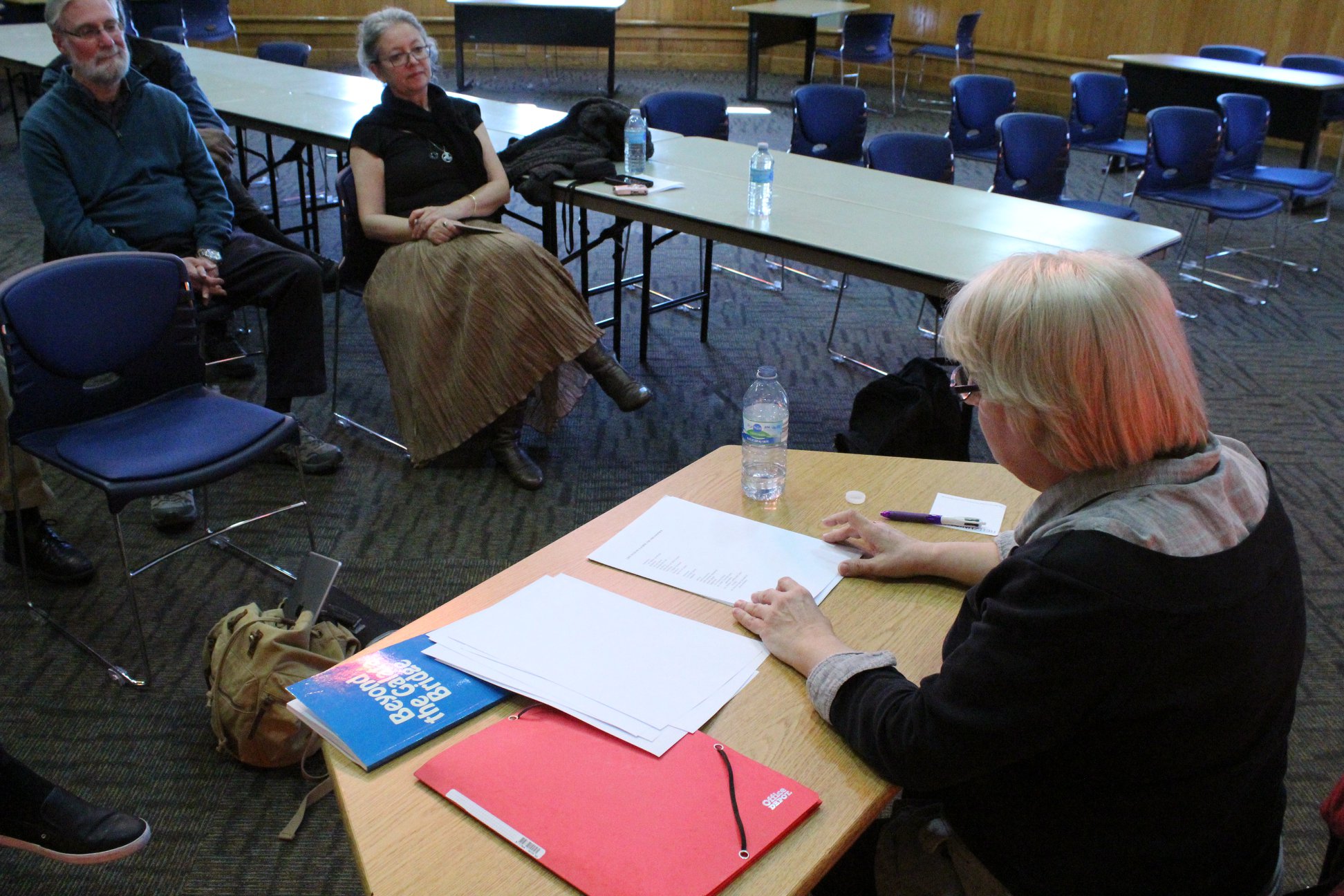
2) Caption: ‘At a book reading event (Alachua County library, downtown), March 2018, Professor Blum-Reid with Andy Gordon, Esther Heboyan (author). [Photo credit: Kole Odutola] – This is an example of a personal picture at an event Professor Blum-Reid organized.
3) Sitting with student Ais Ansy, film class activity, spring 2011 [Photo credit: Debbie Parrales]
4) Leah and Professor Blum-Reid (photo of a student and I at her graduation party, 2011. [Photo credit: Debbie Parrales]
5) Student’s final project for fashion-film class-collage- 2013 [Photo credit: Sylvie Blum-Reid]
6) Self-Portrait- Avignon, 2004 [Photo credit: Sylvie Blum-Reid]
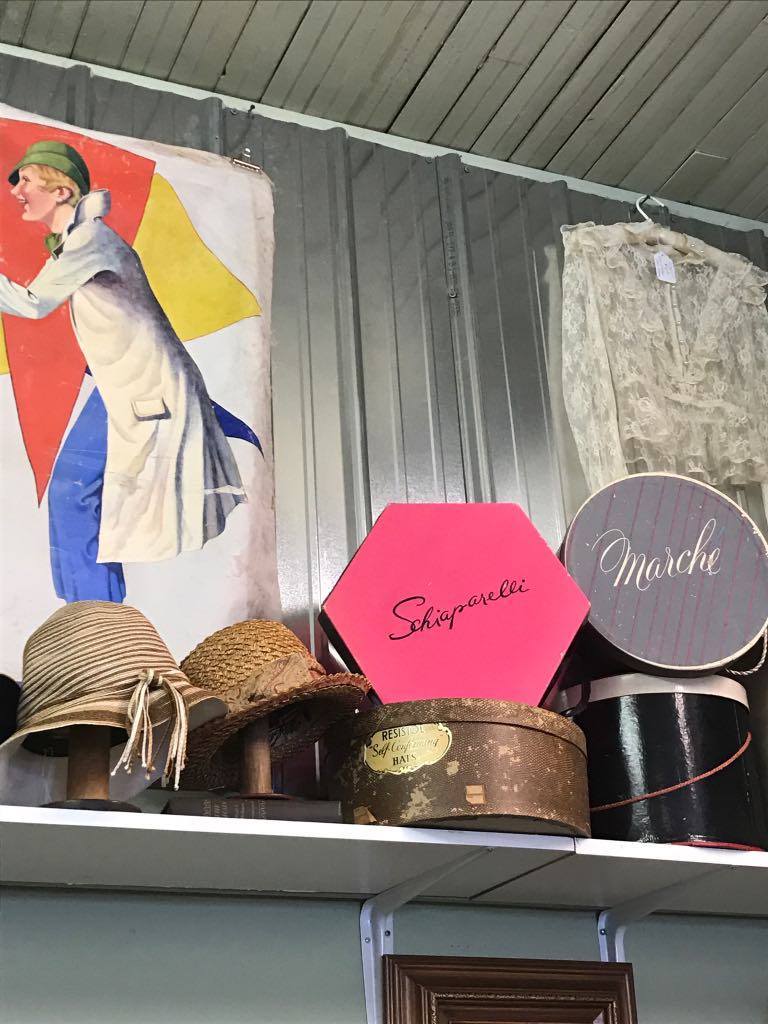
7) Schiaparelli hat box found in vintage clothing shop (Micanopy, Florida, 2017) [Photo credit: Sylvie Blum-Reid]
“I would like to dig deeper into the relatively low-key importance of tailors and couturières (or seamstresses) who helped create and reproduce fashion for the everyday woman who aspired to look stylish from the 1920s onward.”
– Professor Sylvie Blum-Reid
Useful Resources and Links about Professor Blum-Reid
Books
- Traveling in French Cinema (London: Palgrave MacMillan 2016)
- East-West Encounters. Franco-Asian Cinema and Literature (London: Wallflower press/Columbia U.P. 2003)
- An edited anthology, Impressions from Paris: Women Creatives in Interwar Years France (Vernon Press, Nov. 2023).
Fashion-related Articles
- “Else: The foreign femme fatale in Renoir’s La Nuit du Carrefour (1932),” Genre en séries: cinéma, télévision, médias (« Femmes fatales », « hommes en crise » ? Réexaminer les modèles genrés du film noir / “Femmes fatales”, “Men in crisis”? Reexamining gender representations in film noir), #16 (April) 2024. https://doi.org/10.4000/ges.4472
- “Evolving mannequins in Jacques Becker’s Falbalas (1944-1945),” Film, Fashion, Consumption. Vol. six, No. 2, 1 December 2017: 141-156 (16) Intellect. – The essay analyses the role of live and still mannequins in the film as well as the character of the couturier who is a victim of his own desires.
- “Jacques Becker” in The Art of Directing: A Concise Dictionary of France’s Film Directors. Ed. Michael Abecassis, Marceline Bloch. And Felicity Chaplin, Peter Lang, Spring 2023, 55-57. https://www.peterlang.com/document/1307800 – This short piece on Becker addresses his mother’s background as a couturiere and how it has impacted his film career.
Anthology
- Sylvie Eve Blum-Reid, Edited volume Impressions from Paris. Women Creatives in Interwar Years France, Vernon Press, (Jan. 2024) 978-1-64889-735-1, 204 pp. https://www.vernonpress.com/book/1815
- One chapter by Dantzel Cenatiempo is linked to Colette and the flapper style.
- One chapter by Sherry Buckberrough on Sonia Delaunay in Paris (1930s)
Conferences where Professor Blum-Reid presented papers on fashion-related topics:
- From Falbalas (Becker 1945) To Jean-Paul Gaultier: Evolution of the Mannequin” at The End of Fashion conference, Massey University, Wellington, NZ, Invited, 8-9 Dec. 2017
- The Clinical Case of Philippe Clarence in Jacques Becker’s Falbalas,” PsyArt, at a conference in Palermo, Sicily, June 2017.
- “Filming Chanel”, Alliance Française de Gainesville, A Celebration of International Women’s Day: Coco Chanel, March 2014, at a local venue.
Other Links
- Blog
- Facebook (University of Florida French Alumni and Friends)
- As editor of the French studies newsletter, Professor Blum-Reid interviewed a student and featured this in the newsletter. “Spotlight on our students. Christian Dior at UF. French Women and Fashion in French Cinema, Rachel Suarez,” French Newsletter, U. Florida, Fall 2011: 6-7. All other features are now online here.
Note: This article also appears in the debut Spotlyts Magazine print and digital edition dedicated to fashion. Read below for further details.
Spotlyts Spotlights Fashion
The moment is finally here!
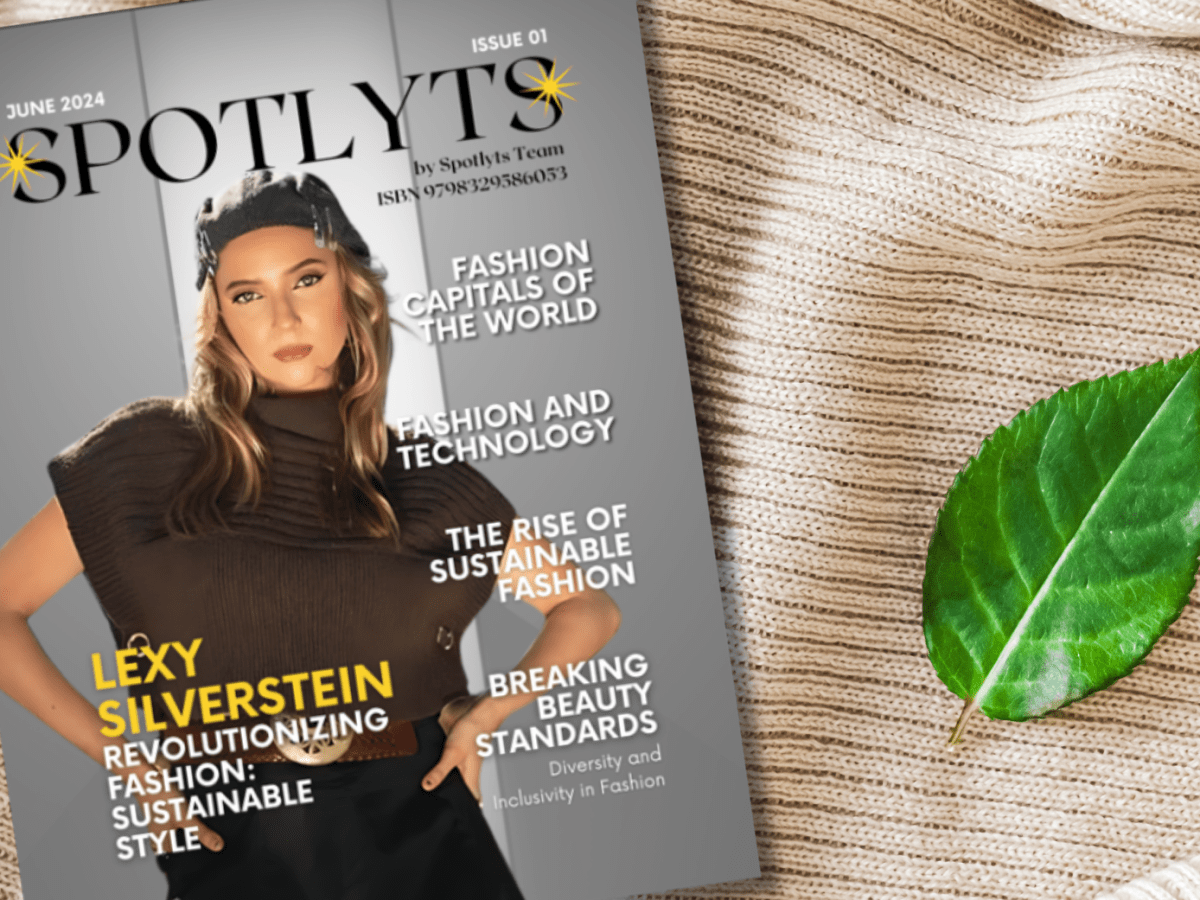
The inaugural issue of Spotlyts Magazine has been officially launched, shining a light on the transformative trends sweeping the fashion industry. Themed “Fashion Forward: Celebrating Diversity, Sustainability, and Innovation,” this edition explores the dynamic changes redefining the sector and features the stories and perspectives driving its evolution.
Gracing the cover is Alexis “Lexy” Silverstein, a champion of sustainable fashion, who embodies the magazine’s mission to highlight individuals, organizations, and initiatives promoting positive change.
This edition features exclusive interviews with notable figures, including:
- Ann Chikahisa, Designer and Owner of Chikahisa Studio, who discusses the impact of fashion and the significance of talismanic jewelry.
- Raegan Kerr, Founder and CEO of The Garde, who shares insights into the concept of elegant athleticism.
- Sylvie Blum-Reid, Professor at the University of Florida, who explores the intersection of women, fashion, and film.
- Emma Medeiros, President of Medeiros Fashion PR, who talks about inclusivity and innovation in fashion.
- Deon Day, Owner of The Eyeshadow Pad, who addresses the revolution in cruelty-free makeup.
- Diana Stelin, TEDx speaker and Owner of Gallerista Fashion, who discusses the artistry in fashion.
- Elizabeth Wissinger, Professor at City University of New York, who offers insights on biodesign, glamour, and wearable technology.
Additional features highlight sustainable fashion, beauty revolutions, and the latest trends, with contributions from:
- Ketie Zhang, Founder of Ketie Story
- Shane McEvoy, Managing Director of Flycast Media
- Alex Taylor, Head of Marketing of CrownTV
- Ryan Esco, Chief Marketing Officer of FireRock Marketing
- Haiko de Poel, Owner of Mass Impact
- Bart Waldon, Co-Founder of Land Boss
- Josh Bluman, Co-Founder of JJ Suspenders
- John Jones, Real Estate Investor of Sell My House Fast Now
- Diane Howard, RN and Founder of Esthetic Finesse
- Fahad Khan, Digital Marketing Manager of Ubuy Nigeria
- Kim Turner, Founder and CEO of Fitness Snob
- Nicolas Krauss, Founder and CEO of dasFlow Custom Sublimation Apparel
- Gary Gilkison, Principal Analyst of Riverbase Cloud
- Ronak Kothari, Creative Director of Rubcorp
- Brian Kratt, Founder and CEO of Plumb Development, Inc
- Kevin Watts, President and Founder of Raincross
- Valentin Radu, CEO of Omniconvert
- Matt Henderson, Co-Owner of Nesta System LLC
- Ben Davis, CEO of The Gents Place
- Kwame McGill, Founder and Owner of Chimney and Stone Masonry LLC
- Eric Neuner, President of NuShoe
- Kristian Longden, Content Marketing Executive of J&J Global Fulfilment
- Tom Molnar, Operations Manager of Fit Design
- Matt Little, Founder and Managing Director of Festoon House
“Spotlyts Magazine Issue 1 – June 2024” celebrates the transformative power of fashion, offering inspiration and insight into a more inclusive, sustainable, and innovative future.
A version of this article also appears on Google News.
Several other versions appear in hundreds of websites across the globe including FOX, CBS, ABC, and NBC affiliates plus more.
Get Your Copy Today
Secure your coffee-table-worthy print and digital copies through the following links:
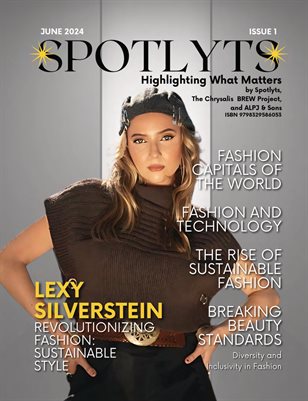
By ALPJ and Sons Team in Spotlyts Magazine
130 pages, published 4/17/2025

- Amazon AU paperback | Kindle
- Amazon UK paperback | Kindle
- Amazon DE paperback | Kindle
- Amazon FR paperback | Kindle
- Amazon ES paperback | Kindle
- Amazon IT paperback | Kindle
- Amazon NL paperback | Kindle
- Amazon PL paperback
- Amazon SE paperback
- Amazon JP paperback | Kindle
- Amazon CA paperback | Kindle
- Amazon US paperback | Kindle
- Amazon BR Kindle
- Amazon MX Kindle
- Amazon IN Kindle
🔆🔆🔆🔆🔆
Related Posts














DISCLAIMER: Spotlyts Magazine does not provide any form of professional advice. All content is for informational purposes only, and the views expressed are those of individual contributors and may not reflect the official position of Spotlyts Magazine. While we strive for accuracy and follow editorial standards, we make no guarantees regarding the completeness or reliability of the content. Readers are encouraged to conduct their own research and seek professional assistance tailored to their specific needs. Any links included are for reference only, and Spotlyts Magazine is not responsible for the content or availability of external sites. For more details, please visit our full Disclaimer, Privacy Policy, and Terms of Service.
Highlight of the Day
“With great power comes great responsibility.”
— Uncle Ben, Spider-Man
More Stories for You

Seasonal Rituals Inspire Global Communities
Ever wondered why we instinctively gather or celebrate when seasons change? This roundup explores how different cultures ritualize nature’s cycles—and what we can learn from these timeless patterns.
Keep reading
The Deal by Nazia Kamali (Short Fiction)
What does a familiar bar reveal when no one is watching? This piece invites readers inside shifts, hidden rituals, and a looming surprise.
Keep reading
In the Spotlight: Leon Conrad on Language, Story Structure, and How Stories Shape Meaning
Why do some stories feel instinctively right while others fall flat—even when we can’t explain why? This interview explores how story structures shape meaning and invites readers to discover the answer.
Keep reading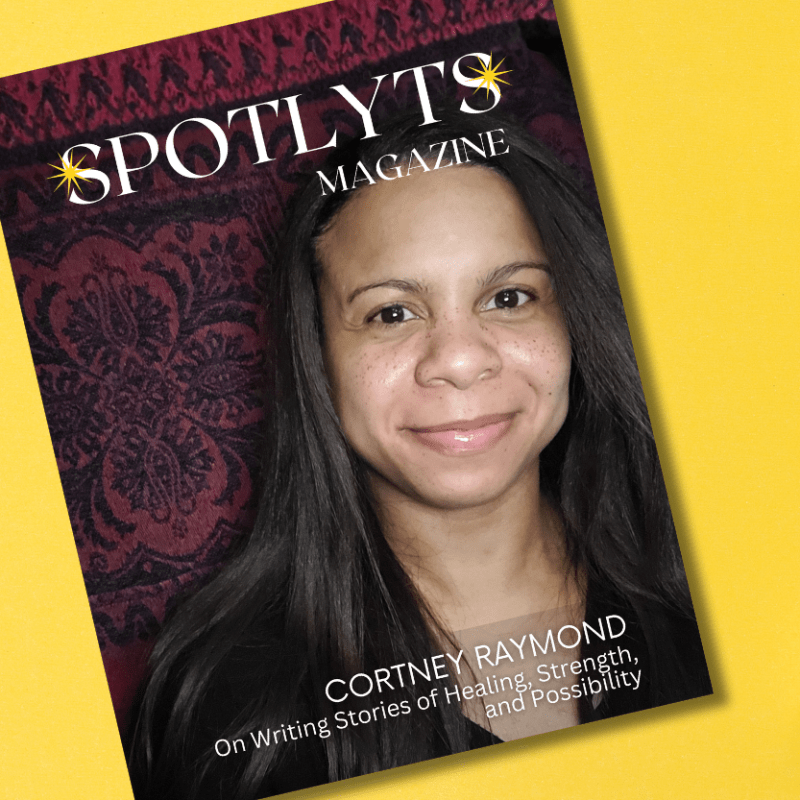
In the Spotlight: Cortney Raymond on Writing Stories of Healing, Strength, and Possibility
Ever wondered what it’s like to write stories that give hope to people who’ve endured trauma? Discover how Cortney Raymond blends real-life experiences and imagination to create resilience, strength, and possibility.
Keep readingSomething went wrong. Please refresh the page and/or try again.

 Spotlyts
Leave a comment