
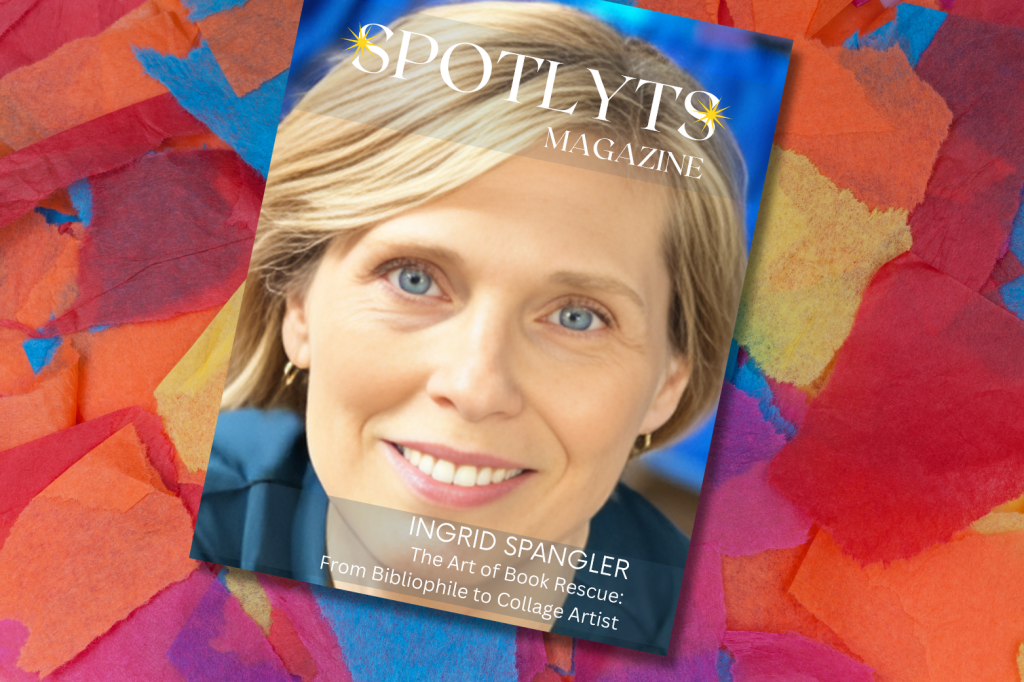
“I have always enjoyed transforming one thing into another… I experimented with different ways to fashion the books into something else, from carving them into sculptures to creating paper wreaths from the pages.”
– Ingrid Spangler
In the following interview, Ingrid Spangler discusses her journey from a bibliophile to a collage artist and how she continues to explore the intersection of creativity and repurposing materials in her work.
SM: Can you share what initially drew you to the world of torn paper collage and how this medium became central to your artistic expression?
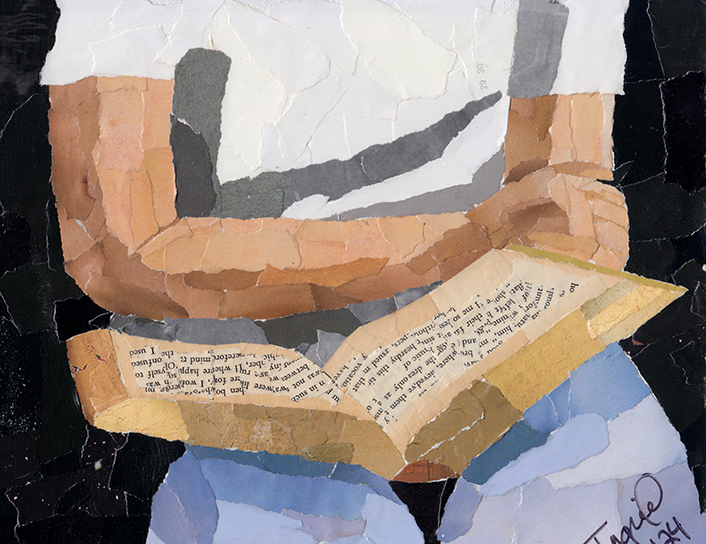
IS: I have always enjoyed making something out of something else. A neighbor was cleaning out and had a bunch of old books that she was tossing out. I thought it looked like a treasure trove for something, but I wasn’t sure what at that time. I experimented with different ways to fashion the books into something else: sketchbooks using the hard covers and binding in blank pages, writing blackout poetry, carving them into boxes, making paper wreaths from the pages, or carving the blocks of pages into sculptures. I have always enjoyed collage and began to play around with some of the more vibrant pages, “painting” other pictures out of the colors. I also explored using acrylic paint to do color washes on the pages with just text, but abandoned that, as I prefer the parameters of only using what I can find in my supply of old/found books. Orson Welles said, “The enemy of art is the absence of limitations.” I love this quote and have found it to be true over and over again. My creativity really kicks in when I have a finite number of possibilities to express myself.
SM: Your art involves “rescuing” old, damaged books. What inspired you to use these materials, and how do you decide which books to repurpose for your work?
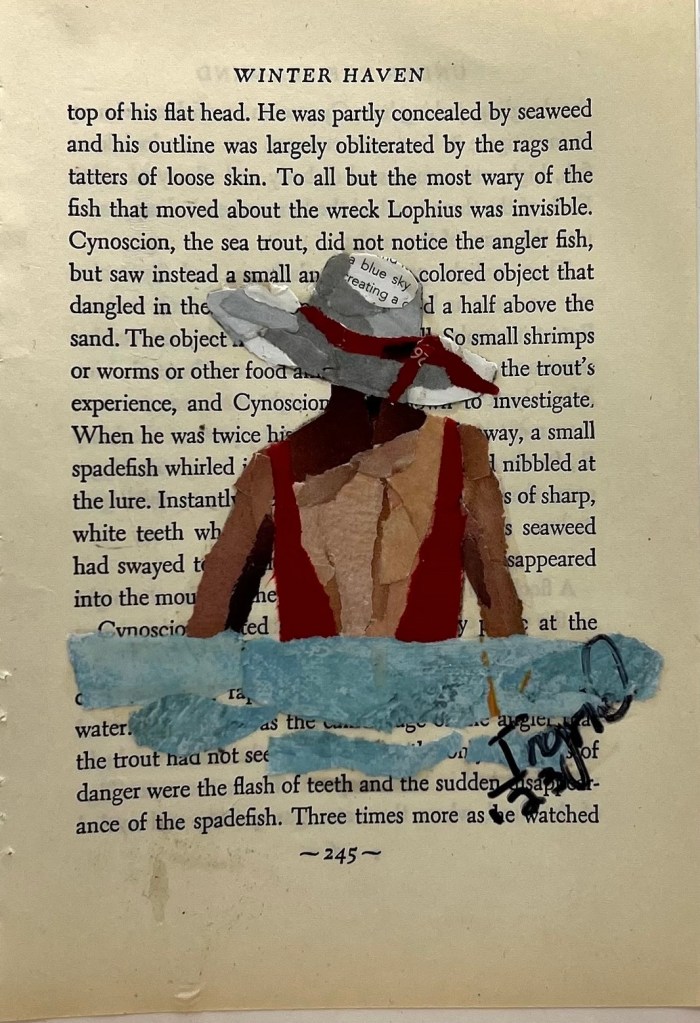
IS: I use books that have lots of colorful illustrations and photographs. I was drawn to torn paper collage but didn’t like working with magazines, as I found the paper to be thinner and less substantial. Also, magazines are recyclable anyway. Yes, book pages are recyclable, but only when taken out of the binding with no glue or stitching. Most people don’t bother and just put them out in the trash or recycling for someone to take. I’m that someone. Reference books in particular cannot be donated anywhere if the info inside is out of date or if a new edition of the book has been published.
SM: Could you describe your creative process from the moment you find a discarded book to the finished collage? What steps do you take in between?
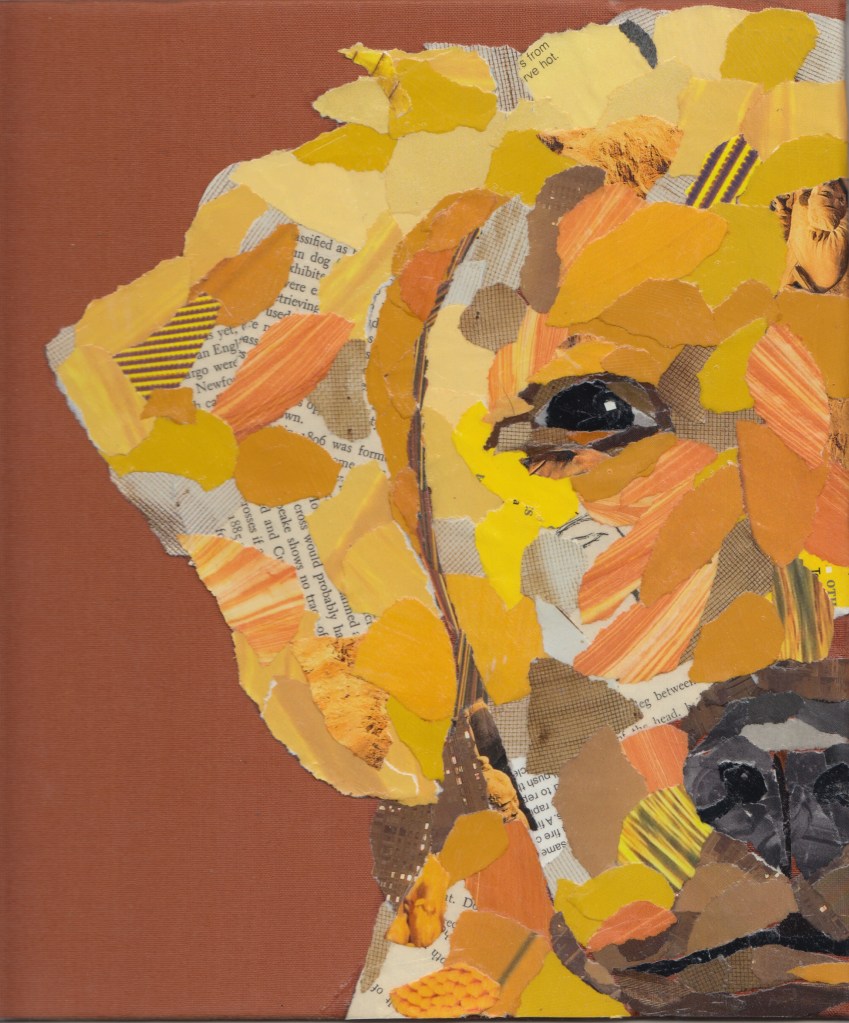
IS: Like any artist, I usually decide on a subject first, then I go through my stash of paper (I keep a filing cabinet filled with paper scraps and pages from books, organized by color) and choose the colors I’ll use. But sometimes I find a book cover or endpaper that’s a really striking color and then something will come to me for that specifically. I had a large coffee table book that had a lovely teal endpaper that was in pretty good shape overall, and I knew I wanted to use the background for something. What came to me right away was a koi pond. I was able to position the koi and lily pads in the “pond” of the teal background to cover the little spots of damage, and the gold/orange color of the fish really popped against the blue-green background that was visible. I also used a dark orange-brown book cover to make a collage of a golden retriever-ish dog. I used a bright yellow endpaper to do sunflowers, and a bright pink one became the background for a Barbie collage.
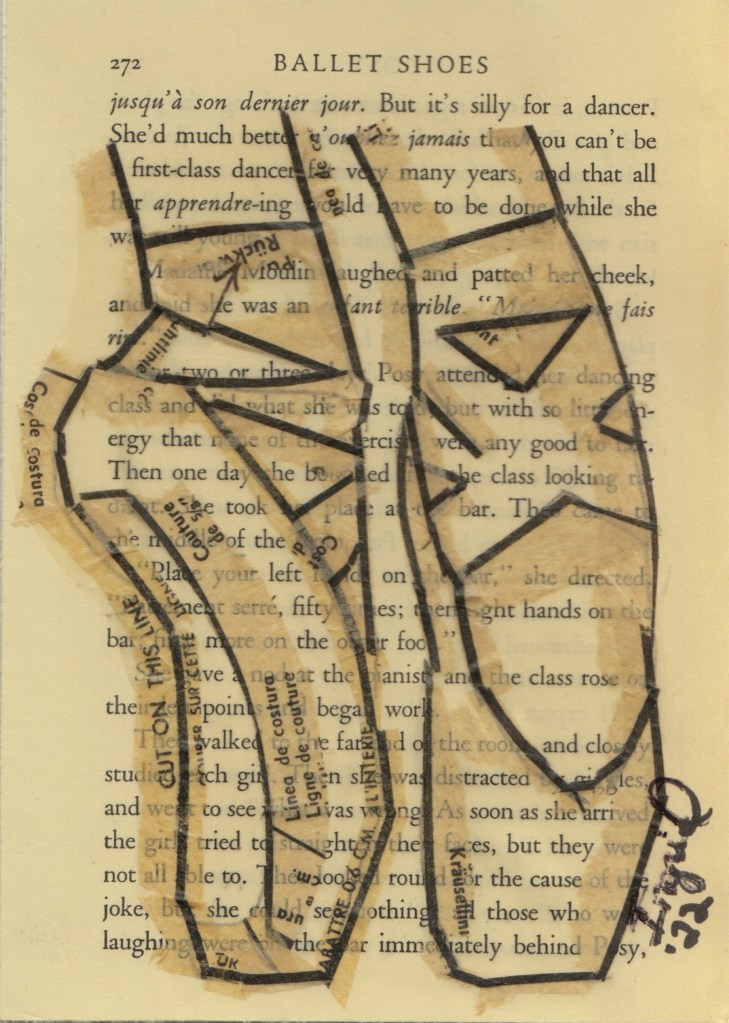
Sometimes I’m looking through a book and see interesting chapter headings or titles. I’ve done ballet shoe collages on pages that had “Ballet Shoes” as the chapter heading. I was thrilled to find a couple of old books that had each of the four seasons as chapter titles and used the pages to mount collages depicting various scenes or birds in those seasons.
The next step is to try to get a good sketch to follow and map it out on my canvas (I try to use discarded hard covers from books as canvases when I can). Then I just start ripping paper and gluing it down. It’s a very intuitive process for me, I usually have TV on in the background. I find when I focus too much on the artwork, I second guess myself. If I have a “comfort” TV show on, like The Office or Arrested Development, it takes up some of my focus and leaves the artistic part of me free to just GO. Because I’ve seen the TV shows before, I’m not paying a lot of attention to them, and it commands just enough focus to free my intuition. I do the collage without really “thinking” too much about it.
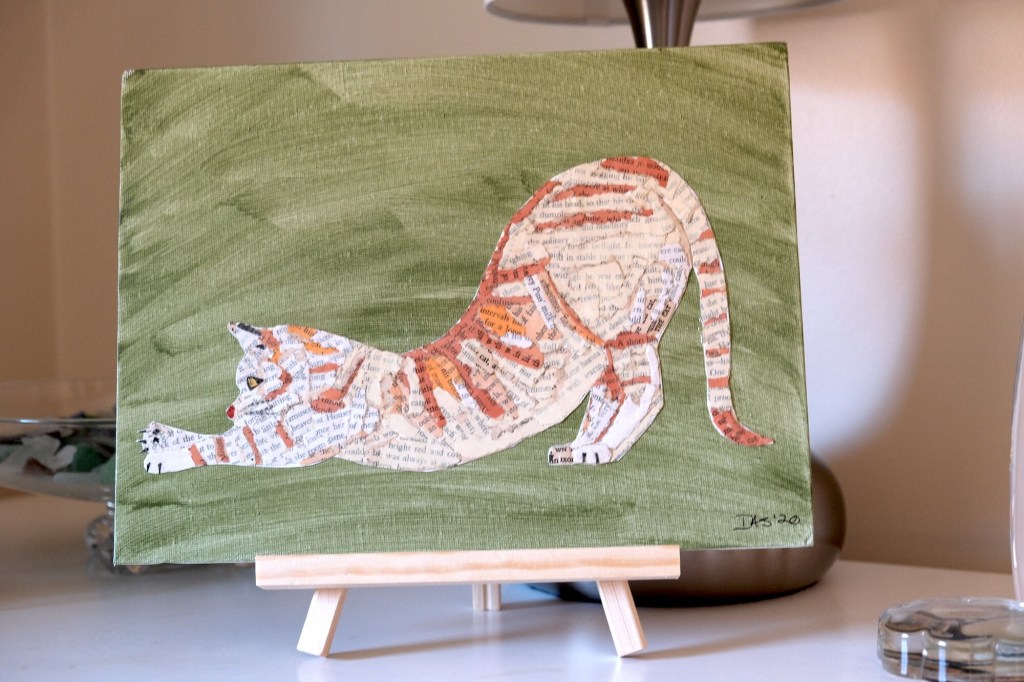
SM: Your collages often feature subjects inspired by nature, human figures, and places. How do these themes influence your work, and do they hold personal significance for you?
IS: Yes! The nostalgia for my childhood in rural PA crops up again and again, and I enjoy creating landscapes, birds (we had a bird feeder and used to have fun identifying them as kids), dogs, and people either in repose or active. Capturing movement is a challenge, but giving a sense of quiet contemplation to a subject who is stationary is more so. Skin tones are also a challenge. In order to convey the curves of a human body, you need several shades of the same skin tone, which is almost always difficult when working with limited supplies. I’d love to do more human figures, but I am limited by what I have on hand as far as colors that can pass for skin tones.
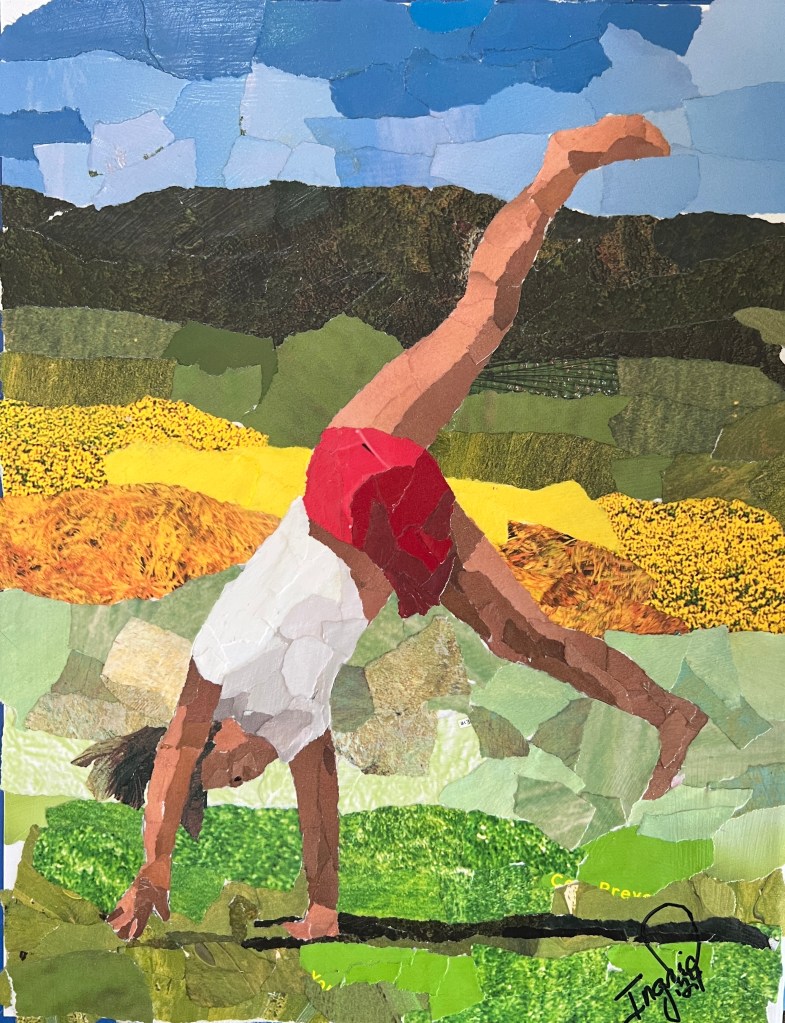
SM: How did your experience in New York’s photography scene and your time working in marketing and social media influence your approach to art today?
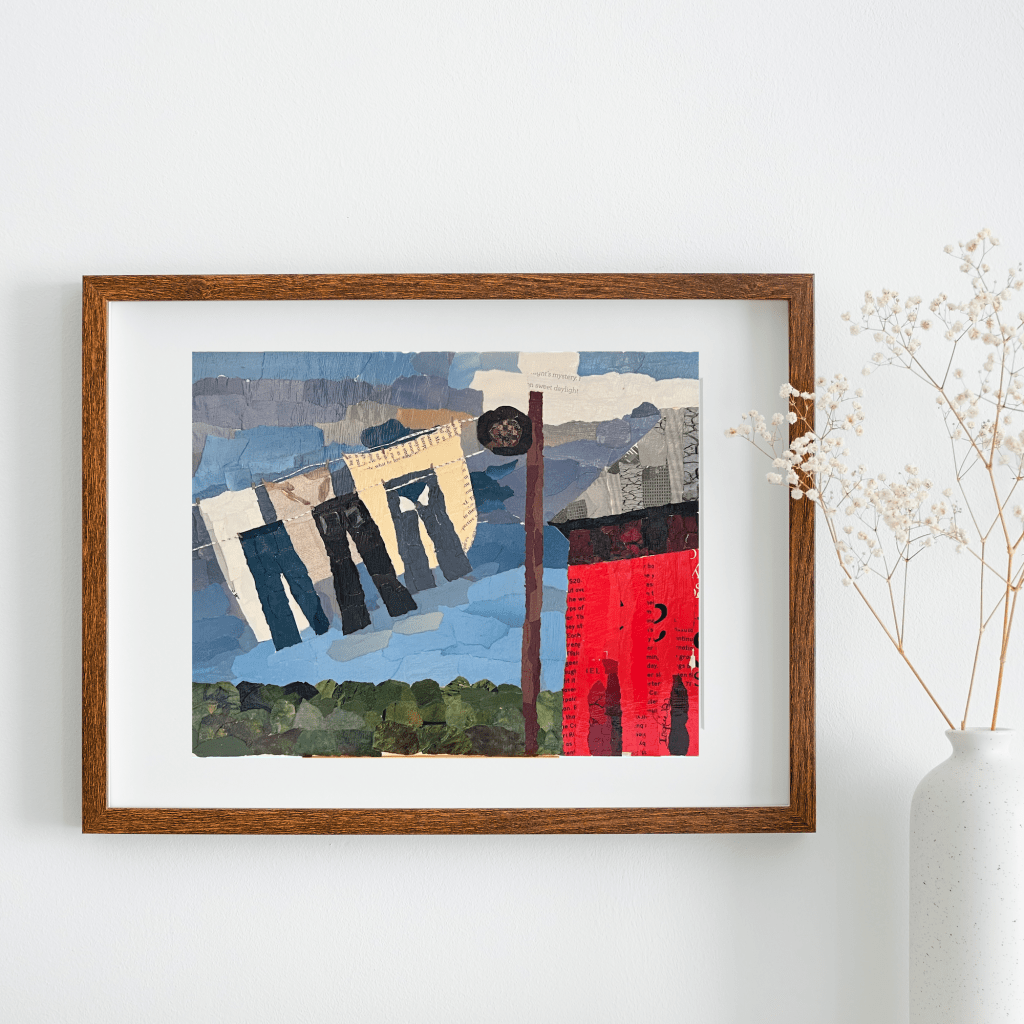
IS: In my photography, I am drawn to “the frame” and specifically what’s inside and what’s outside of it. I shoot a lot of doors and windows because the in-situ frames attract me. The things you can see in them tell you a lot about the people who populate the homes/businesses they’re found in: reflections, what’s displayed on the windowsills, wear and tear, etc. The same with laundry lines. When I lived in NYC, I shot the same apartment building pretty much every day for almost a year, as the people on the top floor seemed to do laundry every day. You can tell a lot about people from how they hang their laundry. Amish washlines in Lancaster County, where I lived briefly, were a favorite subject; they are usually very neat and arranged by size. I’ve done a couple of collages depicting washlines.
From the business end, I’m well aware of the impact social media has on everything these days and try to make lots of posts where I am showing my progress on a piece, especially commissions. But it’s the age-old conundrum of being more comfortable promoting someone else’s work over one’s own.
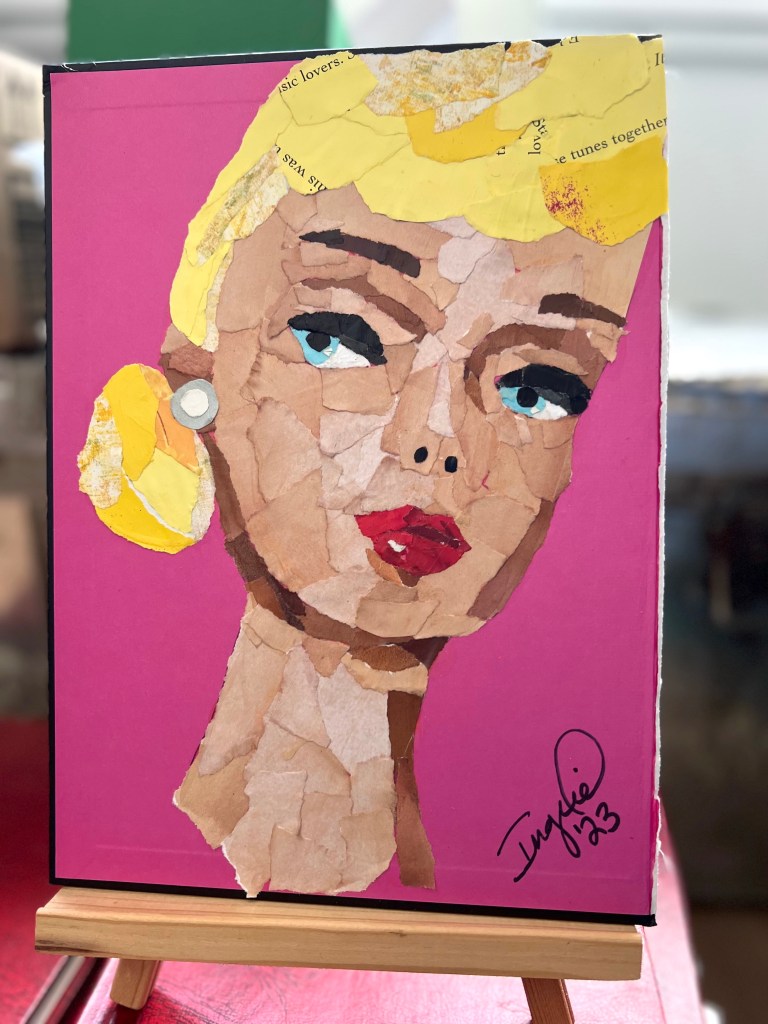
SM: The pandemic was a time of change for many artists. How did this period impact your creative journey, and in what ways did it shape your work with torn paper?
IS: The pandemic was when I started working with torn paper in earnest. A neighbor was getting rid of some books, and I was determined to find a use for them. Because I couldn’t go out much or do a whole lot else, I really stuck to it, and through a lot of trial and error, came up with something very enjoyable and rewarding.
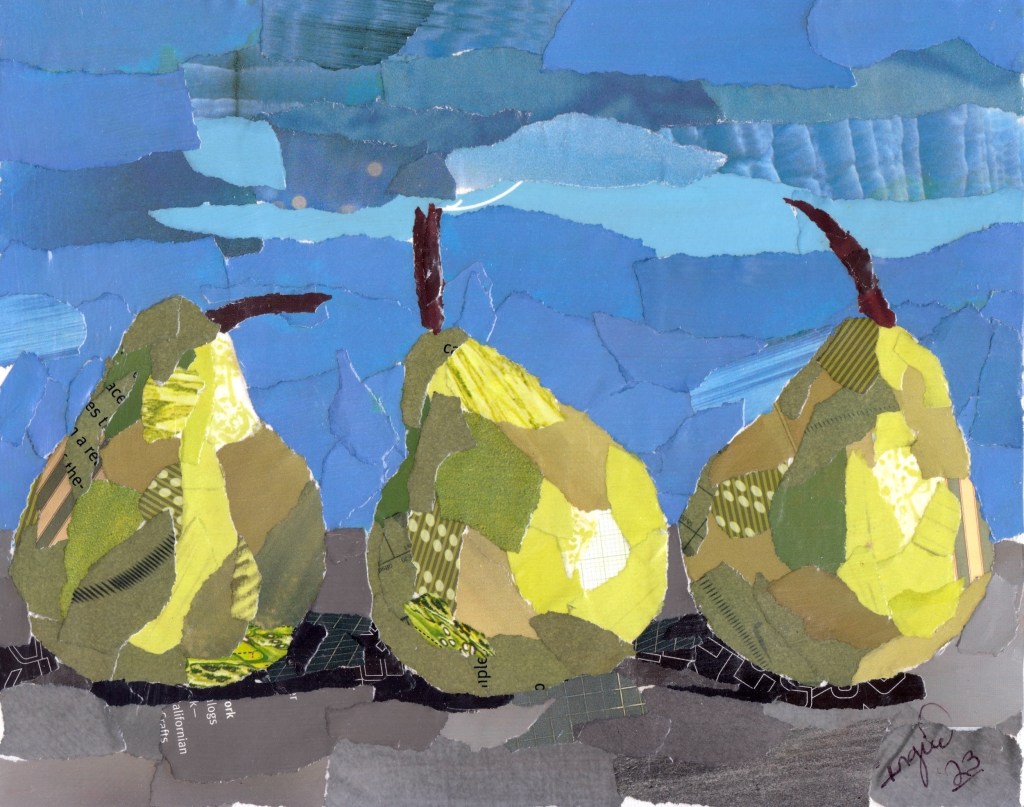
SM: You mention that some of your pieces are created with vintage sewing patterns. What role do these materials play in your work, and how do they differ from using book pages?
IS: Sewing patterns are notoriously difficult to work with, especially since I don’t cut them—I tear, as I like the element of chance that comes with tearing. I don’t work a lot with these, but I do enjoy the bold black lines and the warm tan color of the tissue paper. Growing up, my mother and sister both sewed, and in those days, we had to take “Home Economics” in school, so we all learned to sew. I disliked the precision required to sew successfully and wasn’t very good at it, but I do enjoy working with the patterns as it is nostalgic for me. I have another artist friend who works with the illustrations on the covers of the pattern envelopes, so from time to time, she sends me the insides. I especially like creating retro-looking women from the patterns, as a simultaneous commentary on “women’s work” and standards of beauty.
SM: How does your background in film, video, and philosophy influence the themes, structure, or depth of your collages?
IS: The German director Douglas Sirk is very influential to me in my photography and in my artwork. He’s a formalist and very meticulous in his use of color and mise en scene. Everything in the frame works toward the overall look; nothing is placed by chance or randomly, and I try to do the same in my work. My philosophy studies centered on aesthetic theory, but I can put it in a nutshell by citing Aristotle: he said that humans were essentially hard-wired to enjoy looking at pictures, and when we recognize similarities between what we see and what we are familiar with, that’s when art resonates and has an effect on the viewer. It’s so rewarding to me when someone relates to a piece I’ve created enough to want to live with it and look at it every day. It’s the highest compliment I can imagine.
SM: You’ve participated in several gallery group shows and exhibitions. Are there any particular milestones or accomplishments in your art career that stand out to you?
IS: My first sale. I had a few people encourage me to offer my work for sale, and when I did, I didn’t have a lot of hope that I would sell to anyone who wasn’t my friend or relative. What a shock when my first sale came in, and it was a complete stranger. That’s when I realized that my work was resonating with other people, and it gave me the confidence to go on.
SM: As an artist who is passionate about “book rescue,” how do you hope your work will inspire others in the creative community or the broader public?
IS: I hope people take a second to look at things in a different way. Things that they are just throwing out or things that no longer serve their original purpose may be reborn as something new and exciting. The common phrase is “reduce, reuse, recycle,” but I think there’s another R in there: repurpose. Yes, books are recyclable, but I think they are more valuable as works of art. When I use a book, its utility is preserved forever in a new way.
“I hope people take a second to look at things in a different way. Things that they are just throwing out or things that no longer serve their original purpose may be reborn as something new and exciting.”
– Ingrid Spangler
Link
- Connect with Ingrid via LinkedIn
Share Your Insights
We’d love to hear your thoughts on Ingrid Spangler’s unique approach to art and the concept of “book rescue.” Share your perspective in the comments and join the conversation:
- How do you feel about repurposing old books into art?
- What materials would you use to create something new from discarded items?
- Have you ever found creative inspiration in unexpected places or objects?
Feel free to share your own experiences and insights!
DISCLAIMER: Spotlyts Magazine does not provide any form of professional advice. All content is for informational purposes only, and the views expressed are those of individual contributors and may not reflect the official position of Spotlyts Magazine. While we strive for accuracy and follow editorial standards, we make no guarantees regarding the completeness or reliability of the content. Readers are encouraged to conduct their own research and seek professional assistance tailored to their specific needs. Any links included are for reference only, and Spotlyts Magazine is not responsible for the content or availability of external sites. For more details, please visit our full Disclaimer, Privacy Policy, and Terms of Service.
Highlight of the Day
“With great power comes great responsibility.”
— Uncle Ben, Spider-Man
More Stories for You
Seasonal Rituals Inspire Global Communities
Ever wondered why we instinctively gather or celebrate when seasons change? This roundup explores how different cultures ritualize nature’s cycles—and what we can learn from these timeless patterns.
Keep reading
The Deal by Nazia Kamali (Short Fiction)
What does a familiar bar reveal when no one is watching? This piece invites readers inside shifts, hidden rituals, and a looming surprise.
Keep reading
In the Spotlight: Leon Conrad on Language, Story Structure, and How Stories Shape Meaning
Why do some stories feel instinctively right while others fall flat—even when we can’t explain why? This interview explores how story structures shape meaning and invites readers to discover the answer.
Keep reading
In the Spotlight: Cortney Raymond on Writing Stories of Healing, Strength, and Possibility
Ever wondered what it’s like to write stories that give hope to people who’ve endured trauma? Discover how Cortney Raymond blends real-life experiences and imagination to create resilience, strength, and possibility.
Keep readingSomething went wrong. Please refresh the page and/or try again.
Related Posts
July: Spotlyts Celebrates Visual Art, Design, Architecture & Real Estate
If walls could talk, what stories would they tell about art, design, and architecture? This July, Spotlyts explores how creativity shapes the spaces we live in—past, present, and future.
Keep reading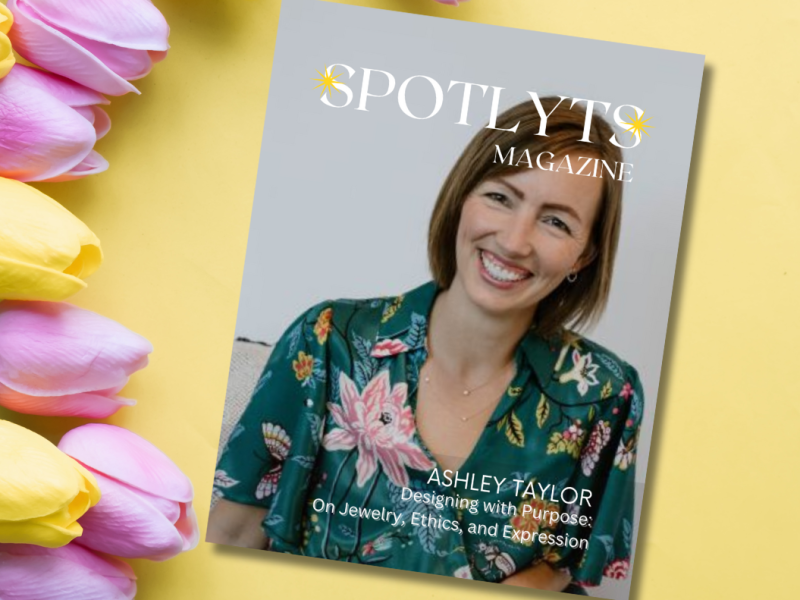
In the Spotlight: Ashley Taylor on Building a Purpose-Driven Jewelry Brand
Can a surprise sketch change the course of a career? Explore how one unexpected moment led Ashley Taylor into jewelry design—and what it reveals about purpose, creativity, and conscious choices.
Keep reading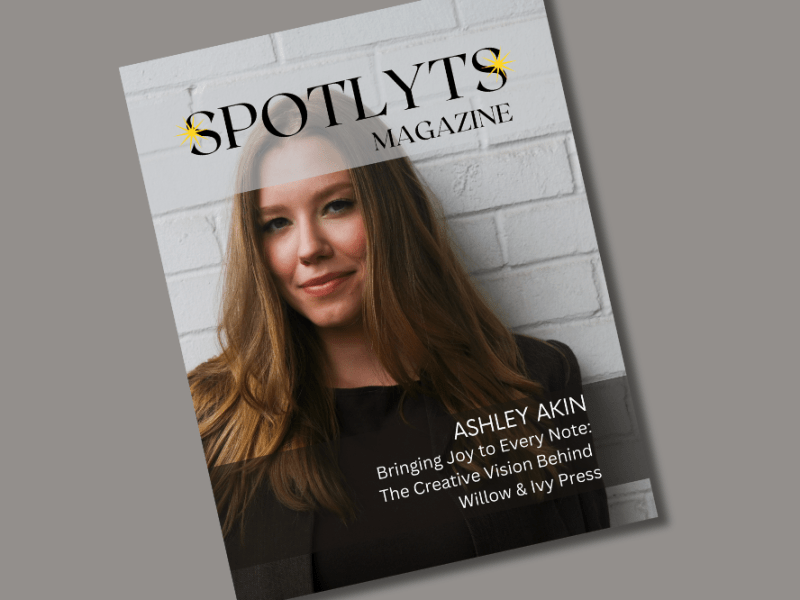
In the Spotlight: Ashley Akin
With Ashley Akin’s enthusiasm for building Willow & Ivy Press from its inception clearly evident, we look into her insights on how the brand is shaping its unique identity in the greeting card market.
Keep reading
Spotlyts Snippets: Biophilic Design and Well-Being
In this fifth installment of Spotlyts Snippets, we get into the world of biophilic design and its impact on well-being. As our built environments evolve, the integration of natural elements into architectural and interior design is gaining momentum and reshaping how we interact with our spaces and enhancing our overall quality of life.
Keep reading
Spotlyts Snippets: On Iconic Building Restorations
In this second installment of Spotlyts Snippets, we highlight the art and science behind restoring iconic buildings, showcasing how these projects blend historical preservation with modern innovation.
Keep reading
Interior Design Tips for Small Spaces: Maximizing Functionality and Style
Here are some easy-to-apply tips that can help you make any small space both functional and stylish.
Keep reading
Affordable Housing Innovations: Balancing Design and Community
Does affordable housing still exist? In this article, experts and leaders share their insights on how innovative strategies are successfully blending design excellence with strong community engagement to create more vibrant and sustainable affordable housing solutions.
Keep reading
Sustainable Architecture: Designing for a Greener Future
With people growing more and more environmentally conscious, sustainability in all things is gaining popularity. The field of architecture is no exception. We are slowly witnessing a convergence of design and environmental consciousness.
Keep reading
Architectural Marvels Around the World: Iconic Buildings and Landmarks
Let us take a brief sojourn from our daily lives and take a moment to admire some of the most fascinating architectural marvels around the world.
Keep reading
The Art in Architecture: The Influence of Art Movements on Modern Design Trends
Here are some of the greatest art movements that have influenced modern design trends.
Keep readingSomething went wrong. Please refresh the page and/or try again.

 Spotlyts
Leave a comment