
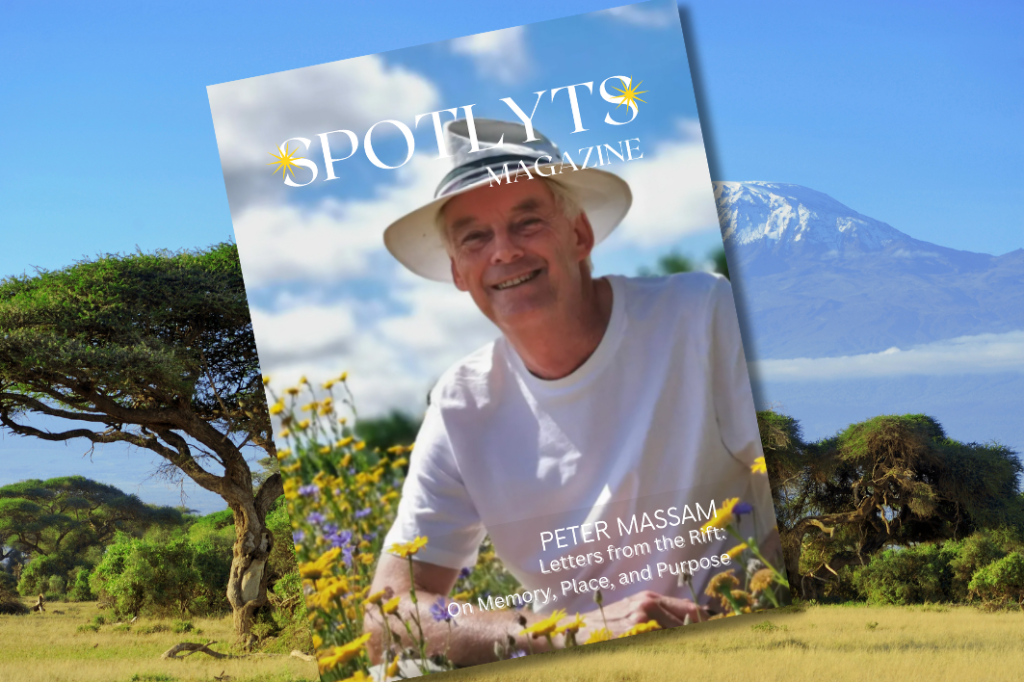
“We are all unique, and we all have stories to tell.”
-Peter Massam
Peter Massam is an Oxford-based author whose Letters from Gilgil trilogy documents his experience living and working in Kenya. His books have received recognition, including the Atlas of Stories Award, Beyond Boundaries Reads Book Award, and Book World Front Award. In this exclusive interview, he shares insights on writing, memory, and long-term cultural impact.
Peter, thank you for joining us today. To begin, could you share a bit about who you are, your background, and what inspired you to revisit and publish your letters from your time in Kenya?
Hi. My name is Peter Massam and I was born in a small village in the house I grew up in at one end of the delightful chalk landscape of the Chiltern Hills, and now I live at the other end of the same hills.
I was fortunate enough to have both parents who believed in education for their children and teachers who believed in the potential of their pupils. I was also very lucky to have teachers at state secondary level and beyond who were truly inspirational.
The first ten years of my working life were spent in the alternative private education sector that continued my education and opened up possibilities to expand my capabilities, to work abroad and to make forays into the exciting and burgeoning networks sector within Information Technology.
A career change moving into business was a mountain to climb, so I applied for deputy headships at the same time. That came to a head when I was offered positions in both on the same day, with one at very much a reduced salary. I took it.
I spent the rest of my career in telecommunications working for suppliers, customer service providers and in application product development—all for the same aim: to make the end customer experience the best it could be.
So from one focus on Customer Experience, I continued the same theme after leaving work to bring out the best in Learning Experiences. This was in fact prompted by my business world’s reluctance to go to the next level and address the softer, more psychological side to customer choice and customer trust.
What made me want to revisit the air mail letters was that they had somehow been misplaced and disappeared. The aim of those letters was simple: to recreate the experience of living and working in Kenya, the sights and the sounds, for my parents who had not been ‘abroad’ since their honeymoon on the Isle of Wight!
This time the personal experiences and reflections would be shared with a wider audience.

Your Letters from Gilgil series is based on real letters you wrote decades ago. What was the emotional and practical process like as you reconstructed those memories into a narrative?
With the letters gone, I only had my slides to fall back on and, apart from the small title labels on the projector carousels, there were no details on exact timings or order of journeys undertaken. They all had to be researched and pieced back together with my memories prompted by the images before me.
As with any delving back into past images, incidents, recollections, laughter and sadness all came back into my relived consciousness without any prompting.
The more practical consideration was to define an order to all personal safaris that took place during holidays or half-terms throughout my two years there.
Then there were the routes to re-assemble. Digital mapping, together with their accompanying street views or—for more remote locations—tourist photos uploaded to the same platform, gave me enough insight to work out the exact roads taken and primary sights seen and recognised. Even with the passage of time, the human element of progress changes some visual aspects, but the mountains, slopes of extinct volcanoes and shores of the Indian Ocean normally do not.
I say normally, because one revealing aspect of the work brought back a more recent history whose impact was unknown and never contemplated at the time. The more graphic examples were images of the glistening coral reef that ran up the coastline and that required special footwear to avoid tearing your skin open on its rough edges. These reefs are now gone.
The Boxing Day disaster of 2004 triggered a tsunami thirty metres high that raced across Indonesia causing utter devastation and massive loss of life. It also did not stop there. When it struck the western side of the same ocean, the waves still had enough force to rip the coral from its foundations and drag it out to sea.
The books are rich in ecological detail—soda lakes, flamingos, volcanic soils, and even Comet Halley. What role did scientific observation play in your writing, and how did your interest in the natural world evolve during your time in Kenya?
Being born in the country in the UK, you come to rely on nature, respect it and trust that, for instance, branches will support your weight from your own experience of what does not.
While in Kenya, you cannot help but take notice of the immense variety of nature that is all around you. The significant difference here was that, added to the different landscapes and vegetation defined largely by height above sea level, there was a whole cacophony of birds and other fauna to watch out for on your isolated travels.
At the end of the introduction, an image of my first journey up into the Aberdare Mountain range, full of trepidation as to whether the jeep would become marooned in some boggy patch off the beaten track, is accompanied by this tiny flower that was the first thing that caught my attention when climbing down from the vehicle. It was bright red and clinging to the granite-like rocks by a thread, but it was still there. “The most beautiful flower I’d ever seen,” I remember thinking, “…and I’m only three weeks into my stay.”
At a garage sale I managed to pick up a couple of field guides to animals and birds of East Africa, but flowers, butterflies and even some trees had to wait till I had time to research their exact names and any distinctions they possessed that I was blissfully unaware of. You have to remember that the Internet was barely underway, so research consisted firstly of two journeys into Nairobi to have the slides developed with a turnaround time of about two to three weeks.
Secondly, you were more reliant on friends’ and colleagues’ personal testimonies that could conflict with one another. Some of the research, as you will encounter in the trilogy, took those four decades to finally discover what beauty—and sometimes rarity—had been captured.
So the blessing of revisiting these images was the genuine surprise with some flora and fauna that were jewels waiting to be rediscovered. One example was a beautiful swallowtail butterfly that I recognised from its form, but the colouring was different. When I looked it up, I was amazed that it was only to be found in the Rift Valley area and, furthermore, only on my side of the valley—the East side.
The evolution of observations was really down to spending time in the evenings, by a Tilly lamp under canvas or by electric light at home at the end of an excursion, to look up things spotted through the day and mark them as such in the books I had to hand. It was another education on a grand scale.
You’ve taken care to portray people and cultures with deep respect—never sensationalizing or generalizing. How did you approach writing about communities so different from your own, and what did you learn from them that has stayed with you?
First and foremost, you’re an observer and you’re there to learn. They know the land, the lakes, the coast, the best sources of sustenance and limits placed on them by their surroundings. The common thread running through both our existences is, of course, common sense. For example, they choose to surround their living area with acacia branches and thorns in a boma to protect them from wild animals. We would do the same in their position.
One prerequisite is to leave the world you knew behind you. That’s a good starting point.
There are many lessons learned from all the people spoken with and the lives shared, among them the importance of community. Helping each other out in good times and bad should go without saying, but the loss of it devalues the society you live in. It is unbalanced, perhaps in favour of values not shared by all—ones that can promote silent, gradual alienation in and between communities that threaten the common good.
An invitation to attend a ritual on the shores of Lake Turkana had to earn the respect of those asking, so that capturing customs on film are not seen as disrespectful but a celebration of their culture which they were happy to share. No special event, no treat for tourists—as there were none—just the unison heartbeat of feet on shorefront, colourful displays of unanimity of purpose and identity.
Other lessons learned would be the importance of simplicity, listening to the sounds of the night, looking up at the starlit wonderment that is the Milky Way above your head with Polaris on one horizon and the Southern Cross on the opposite one, realising how precious moments are and the good fortune you enjoy every day but gladly ignore.
A local man’s ritual of climbing Mt. Kenya in nothing but shorts and sandals every year to pay homage to the mountain is a reverence we miss, as it doesn’t make social media—but many understand its significance and know of it for miles around.
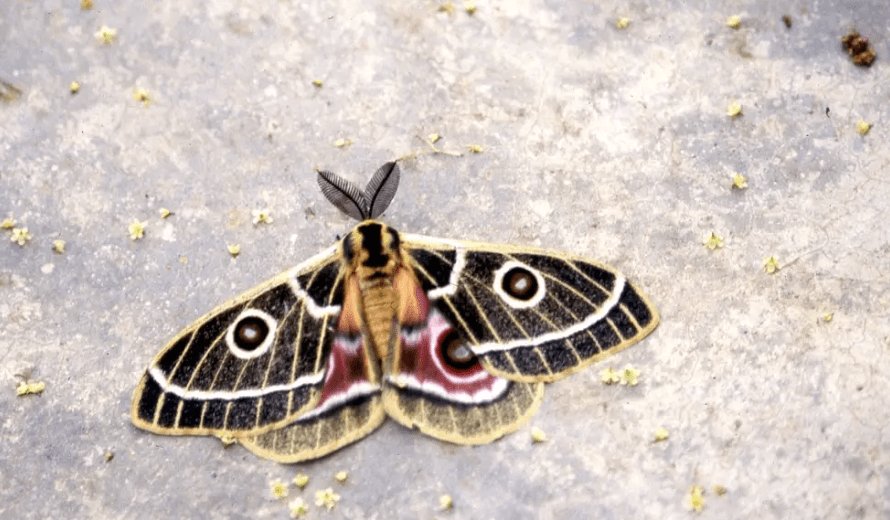
Photography clearly plays a role in your storytelling, especially with your inclusion of slides. How did your background with photography influence the way you write or remember certain places and moments?
On the practical side, the slides informed my journeys and helped me place locations, match timings and revive memories of why they had been taken at the time.
On the creative side, taking slides is much like art in their composition. Artists would add trees to a landscape where none existed—forgiven by ‘artistic licence’—or widen a canal as Turner did to accommodate a larger vessel worthy of one of his sunsets. The purpose, as many will know, is to lead the eye of the beholder around the canvas to come full circle (ideally) back to where it began.
The same is true of slides, normally referred to as the framing of subject and surroundings. Of course, in a dynamic setting with the action coursing in front of you, you’ve only the briefest of moments to scan the backdrop before gently pressing the shutter button.
An acacia tree once seen is remembered not only for its delicate leaves that provide light shade from searing heat and manna for giraffes and elephants alike, but also for its predictable one or more trunks that arch gracefully outwards on both sides. So bringing an acacia tree into the frame guarantees an arching lead to any eye on that side of the canvas.
It’s much the same with storytelling. You can begin by describing the bushes, trees and flora close to you, but on scanning wider and higher, you can bring to eye and ear what you intended to portray all along from a single slide—the awe-inspiring magnificence of a cloud line tumbling over the topmost ridges of the hills off to your right and rolling down gently towards their base, not a hundred metres from where you stand. The message is a reminder of the elevation you are constantly at in Kenya that makes these experiences possible.
A slide captured that moment. In reality, the cloud would almost never reach the ground as it dissipates a couple of hundred metres into its descent, but the moment stays with you.
In the third volume, you reflect on cultural and environmental loss—like the fading El Molo language. In your view, what’s the importance of documentation?
It’s up to each and every one of us to record our own experiences for future generations.
We are all unique, and we all have stories to tell. In medieval times, that was the lingua franca around the camp or hall fire and, if told memorably enough—perhaps embellished a little along the way—would be recalled and requested to be told anew for everyone’s pleasure time and again.
In writing these experiences down, one of the prerequisites for me is longevity. Whether it’s read today or read aloud tomorrow or a hundred years from now, it should resonate with the reader as if it happened to them yesterday.
In providing even one person’s view of an event or historical recollection, you are preserving that moment, that experience, that culture and that people—just as layers of their ancient rocks kept safe fossils of their ancestors’ lives and their surroundings. Just as we are still discovering what lies beneath those layers every week with some new revelation, so there are moments already lived that need to be committed to records forever.
The books are more than memoir—they also support a cause. Can you tell us how Letters from Gilgil is connected to community initiatives and what kind of impact you hope these stories will have beyond the page?
In my view, every book needs a purpose.
The vast majority that have followed this path will know that going into this noble undertaking—as a profession or a pastime—is not done so for self-wealth creation.
The exceptions may grab the headlines, and they may choose to discharge their gains wherever their insight leads them, but for me the motivation has to be one you believe in and will commit to. The link you then forge with the underlying purpose becomes that much stronger and drives you to write better because it has passion from inside.
The initiatives that this trilogy speaks to are the hundreds and thousands of children across the world who are disadvantaged and deprived of an education. As one who was given a chance at that young age by a headmistress who believed in the potential rather than a simple score on a test sheet, I know how much that means to any child.
Providing support to the droves of helpers, staff, volunteers, suppliers who make exceptions, village elders and leaders in their communities means the continuation and affirmation that their passionate desire will fill that yawning gap.
The hope is that the books give an insight into why there are some things worth preserving, while there are others that society and humanity simply cannot do without.
What did returning to these stories decades later teach you about yourself—whether as a teacher, traveller, or human being navigating memory and change?
That you should never give up.
Things that were lost may never be found, but the intention of the content of those letters could be recreated—and along the way, perhaps perceive just a momentary glimpse of a smile of recognition, amusement or amazement between the lines on the unforgotten face of a close friend and mother or on the chiselled brow of a resting father.
Many readers have found these books to be quietly powerful—without sensationalism, just deep attentiveness. How would you describe your writing philosophy or voice, especially when writing for families and younger readers?
It is important for all of them to be accessible. These are instances that have made me sit up and take notice. I hope it may stir the same in others.
For young families, it can be hard to find that quiet time when life can be appreciated together. I could point to the few times a father and son might play on the same cricket team—either socially or in a village setting—or to a football match played barefoot on holiday with local Greeks on what seemed like a crushed pumice surface. Those moments together linger long after the event, the year, and the decade have passed.
Appreciate the blessings around us and make best use of the experiences that have moulded us—whether for better or worse. They all count. They can all inform and help others.
For anyone considering documenting their own travels, service, or long-past experiences—what advice would you offer about the value of storytelling, especially when it’s done with integrity and reflection?
Be yourself.
No one else is like you, acts or engages with people as you do.
So much can be left unsaid, and the temptation is to put everything in that stone vessel and seal the lid tight shut.
The reopening of such a store of memories, however far into the future, may reveal some deep-seated wounds that surface from time to time in the present even with the lid closed, but exposing them to others can halve the problem with every retelling or re-reading to allow yourself and others to heal.
Only then can the true unbridled humour and joy of what you’ve experienced—and hope still to do—be revealed in all its glory, good-naturedness and willingness to help others, shared in the knowledge that there will be many others who resonate with your words and are glad they are not alone in facing challenges or in rejoicing in those special life moments.

If you were to write your bio in your own words, what would you say? What legacy do you hope to leave?
Peter Massam is an Oxford-based author known for his fluid and reflective storytelling. Since 2022, he has written poetry, sketches, and two trilogies, drawing inspiration from personal experiences and extensive travels. His work blends introspection with engaging narratives that resonate with readers seeking meaning in everyday life.
University life took me away to Durham to study French and Russian, and my first formative ten work years were spent learning the valuable trade of school mastering, both in the UK and in Kenya. Plato helped me develop an individual approach to instilling a sense of the joys of French, Maths, Music, early introductions to IT networks, and of course Sport.
Securing a place in business was massive. The career change, once achieved, was the springboard to finding out what I really wanted to do.
Working in different environments enhanced my understanding of operations, business processes, and customer-facing sales and marketing. I engaged willingly with every possible department including legal and finance, to understand everyone’s point of view and experience on the ground.
This laid the foundation of my focus on Experience with a strong desire for innovation. The creative push can be attributed to a strong Arts foundation, but my practical side (inherited from my craftsman engineer father) prompted me to complement that side with a Science degree, linked directly to my work, at Master’s level.
I felt this combination described my outlook and approach to problem-solving more than adequately. It also pre-empted the reason for publishing my first book in 2003.
Many successful years in business ensued—with three redundancies en route (so not all plain sailing for sure)—but that did not deter my purpose.
One highlight was directing a product line in my chosen passion for seven years, having a patent published for it, and moving on from building a new operational model for a mobile start-up company to develop a globally recognised standard of a digital maturity model with customer experience at its head.
Both COVID-19 and then retirement afforded me the time to focus on what I really wanted to do next, and that was—and is—writing in different formats to reach a variety of audiences worldwide and, through my works, support those who may be going through a tough time, to give them tools to cope and help them forge a future that is waiting for them all.
I’m not sure what legacy will remain. It’s not a single act or one accomplishment that sets your contribution apart, but the lessons you’ve learned from a whole host of experiences that you wish to share and embrace with your fellow man (he/she).
My most fervent wish is to continue to support disadvantaged children with the right to education they deserve, so that they too can make their own life choices, without being forced down a path through circumstance or overbearing, exploitative individuals that care only for their own selfish ends. A child’s life is sacrosanct. Never forget it is their life and their choices that will lead your future. Help them to be the best they can be.
“A child’s life is sacrosanct—never forget it is their life and their choices that will lead your future.”
-Peter Massam
Links
Share Your Insights
We’d love to hear your thoughts on Peter Massam’s journey and reflections. Join the conversation by sharing your answers in the comments:
- Why do you think storytelling still holds value today?
- What personal experiences have you felt compelled to document or share?
- How do you preserve memories that matter most to you?
DISCLAIMER: Spotlyts Magazine does not provide any form of professional advice. All content is for informational purposes only, and the views expressed are those of individual contributors and may not reflect the official position of Spotlyts Magazine. While we strive for accuracy and follow editorial standards, we make no guarantees regarding the completeness or reliability of the content. Readers are encouraged to conduct their own research and seek professional assistance tailored to their specific needs. Any links included are for reference only, and Spotlyts Magazine is not responsible for the content or availability of external sites. For more details, please visit our full Disclaimer, Privacy Policy, and Terms of Service.
Highlight of the Day
“With great power comes great responsibility.”
— Uncle Ben, Spider-Man
More Stories for You

Seasonal Rituals Inspire Global Communities
Ever wondered why we instinctively gather or celebrate when seasons change? This roundup explores how different cultures ritualize nature’s cycles—and what we can learn from these timeless patterns.
Keep reading
The Deal by Nazia Kamali (Short Fiction)
What does a familiar bar reveal when no one is watching? This piece invites readers inside shifts, hidden rituals, and a looming surprise.
Keep reading
In the Spotlight: Leon Conrad on Language, Story Structure, and How Stories Shape Meaning
Why do some stories feel instinctively right while others fall flat—even when we can’t explain why? This interview explores how story structures shape meaning and invites readers to discover the answer.
Keep reading
In the Spotlight: Cortney Raymond on Writing Stories of Healing, Strength, and Possibility
Ever wondered what it’s like to write stories that give hope to people who’ve endured trauma? Discover how Cortney Raymond blends real-life experiences and imagination to create resilience, strength, and possibility.
Keep readingSomething went wrong. Please refresh the page and/or try again.
Related Posts
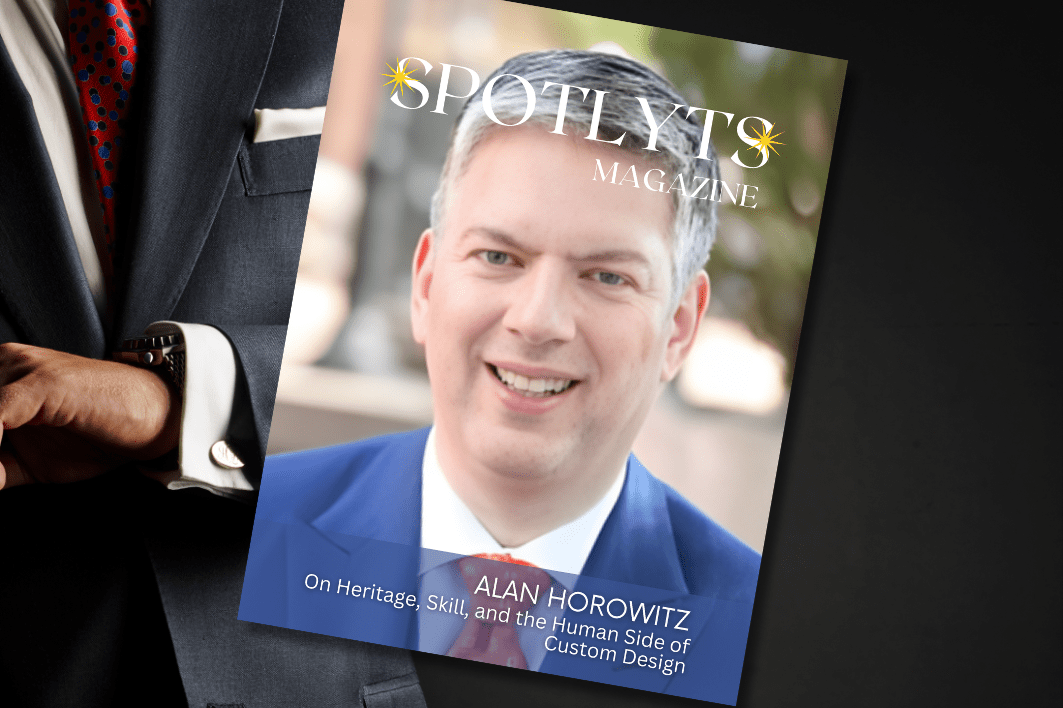
In the Spotlight: Alan Horowitz on Heritage, Skill, and the Human Side of Custom Design
What happens when decades of family tradition meet modern demands for fit, quality, and purpose? Discover how Alan David Horowitz adapts bespoke tailoring to today’s world in this interview.
Keep reading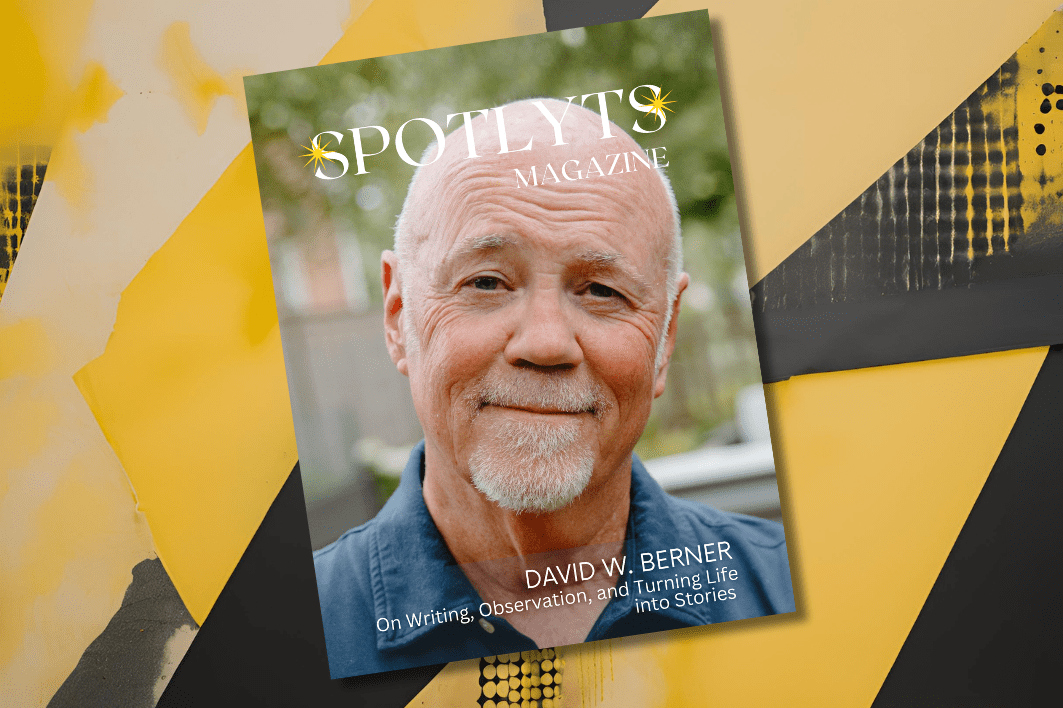
In the Spotlight: David W. Berner on Writing, Observation, and Turning Life into Stories
What if time itself were the story’s quiet narrator? This interview explores how a writer reflects on aging, creativity, and attention—inviting readers to discover the answers by reading the full conversation.
Keep reading
In the Spotlight: Talia Mashiach
Have you ever wondered what happens when creative chaos meets strict financial rules on a film set? This piece explores that intersection through Talia Mashiach’s experiences—read on to uncover perspective.
Keep reading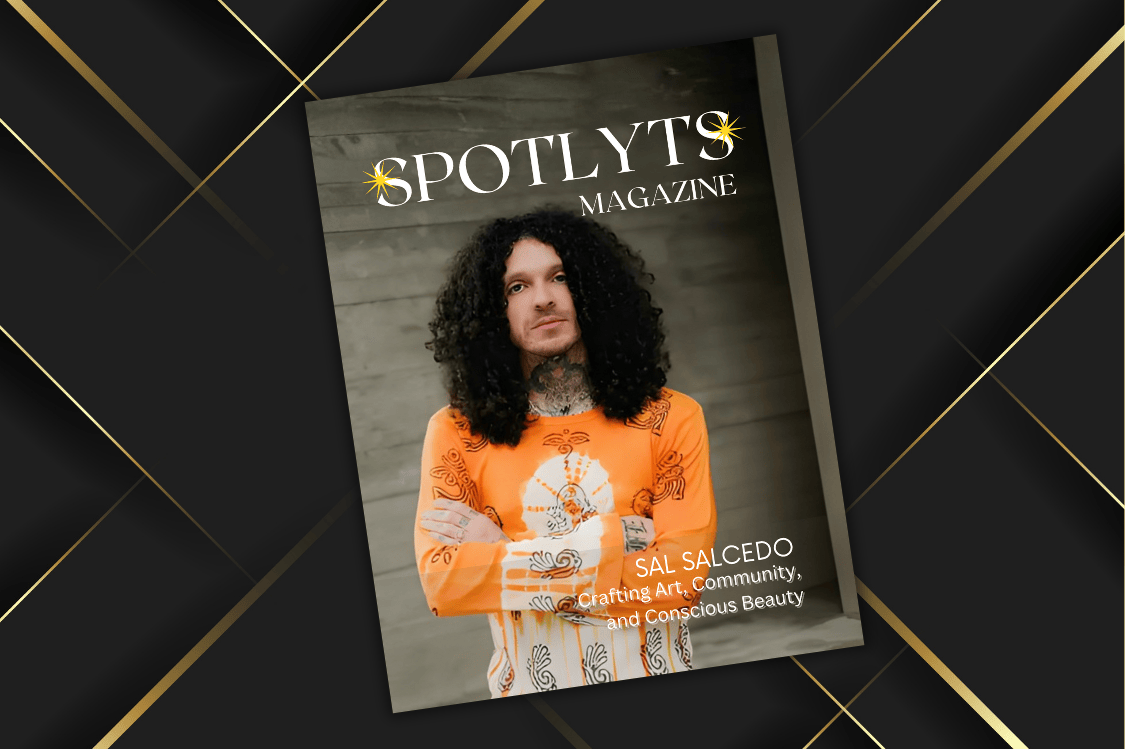
In the Spotlight: Sal Salcedo on Crafting Art, Community, and Conscious Beauty
Have you ever wondered if a haircut could spark a deeper connection to who you are and the world around you? Discover how Sal Salcedo explores this idea through his artistic journey.
Keep readingSomething went wrong. Please refresh the page and/or try again.

 Spotlyts
Leave a comment